
Overview
Hydraulic systems are widely used in many fields, such as industry, aviation, and agriculture. The working principle of the hydraulic system is based on the mechanical properties of fluids. The system transmits forces through the fluid to achieve motion control of mechanical devices. In the hydraulic system, solenoid hydraulic valve is one of the key components that play a role in controlling the flow of fluid. This paper will briefly introduce the pneumatic principle of the hydraulic system and the solenoid hydraulic valve.
Pneumatic Principles of Hydraulic Systems
The pneumatic principles of hydraulic systems are based on the basic laws of fluid mechanics, including Lorentz’s law and Bhaskar’s law.
1. Lorentz’s law: Lorentz’s law describes the kinetic properties of liquids in the flow process. According to this law, a liquid has a certain mass and momentum during transport and is subject to external forces that change its velocity and direction.
2. Bhaskar’s Law: Bhaskar’s Law is one of the fundamental principles of hydraulics. The law states that if you apply pressure at one point in the fluid, the fluid will transmit this pressure uniformly, and you will feel the same pressure at any point connected to the origin.
Hydraulic systems realise the transmission of mechanical devices over long distances and the amplification of forces according to the above principles. Hydraulic systems regulate the pressure of fluids precisely. They also use suitable hydraulic cylinders and motors. This allows them to drive a wide range of mechanical devices for motion control.
The role of solenoid hydraulic valve
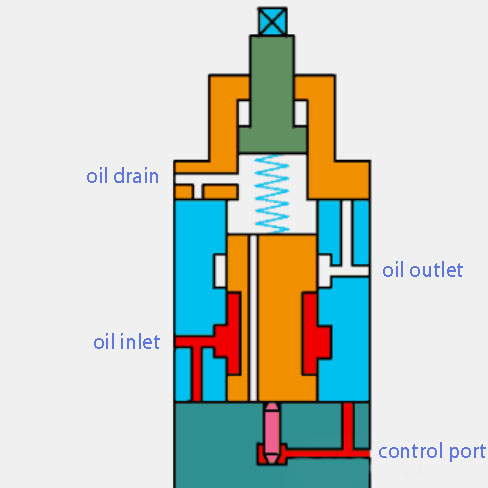
Solenoid hydraulic valve is one of the important control components in the hydraulic system. It can open or close the fluid path through the control of electromagnetism, so as to achieve the control of the flow of liquid. The working principle of a solenoid hydraulic valve involves driving the valve spool’s opening or closing. This is achieved through the electromagnetic force generated by current excitation.
The solenoid hydraulic valve mainly includes components such as the spool, seat, solenoid, and spring. When the solenoid energizes, the electromagnetic force overcomes the spring force. This action causes the spool to open or close the valve seat. As a result, the state of the pathway changes. When the solenoid is de-energised, the spool will be closed or opened again by the spring force.
Solenoid hydraulic valves offer remote control capability, a fast response time, and the ability to control complex fluid functions through circuit control.
Conclusion
The hydraulic system applies the basic laws of fluid mechanics and achieves motion control of mechanical devices through fluid transmission. The solenoid hydraulic valve, an important control element in the hydraulic system, uses electromagnetic force to control the fluid. Hydraulic systems have a wide range of applications in industry and other fields, providing stable power control for the operation of mechanical devices.
Contact Zhuo Yi Control Technology for the latest production technology!


