How injection moulding machines work
Injection moulding machines are plastic molding machines whose working process mainly includes four key stages: heating, mold closing, injection, and pressure holding. The injection moulding machines inject granular plastic material into the closed mold cavity after heating and plasticizing it. The material is kept under a certain pressure for a period of time. After cooling, the mold is opened, and the molded plastic products are taken out. Its basic structure includes hopper feeder, screw, heating system, injection mechanism, mould and so on. Injection moulding is a cyclic production process with strong periodicity.
The transmission system of the injection moulding machine mainly focuses on precision control and energy saving, and is mainly divided into all-hydraulic drive system, electro-hydraulic hybrid drive system and all-electric servo drive system according to different drive methods.
Fully hydraulic drive system
Working principle of fully hydraulic drive
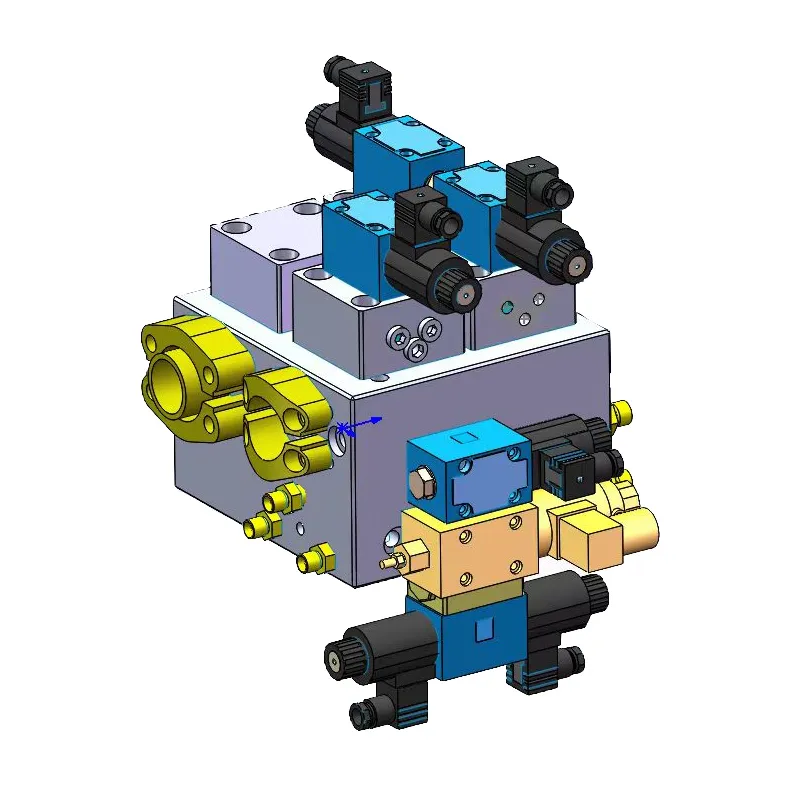
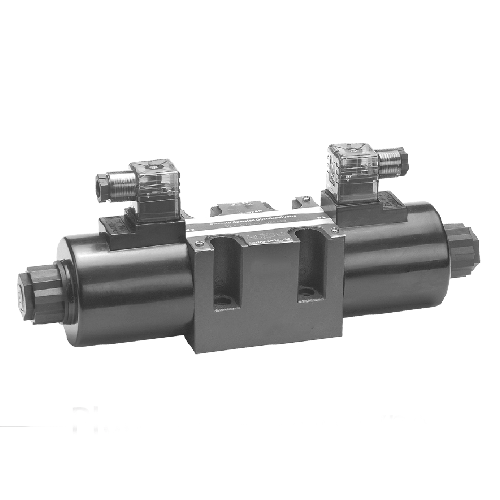
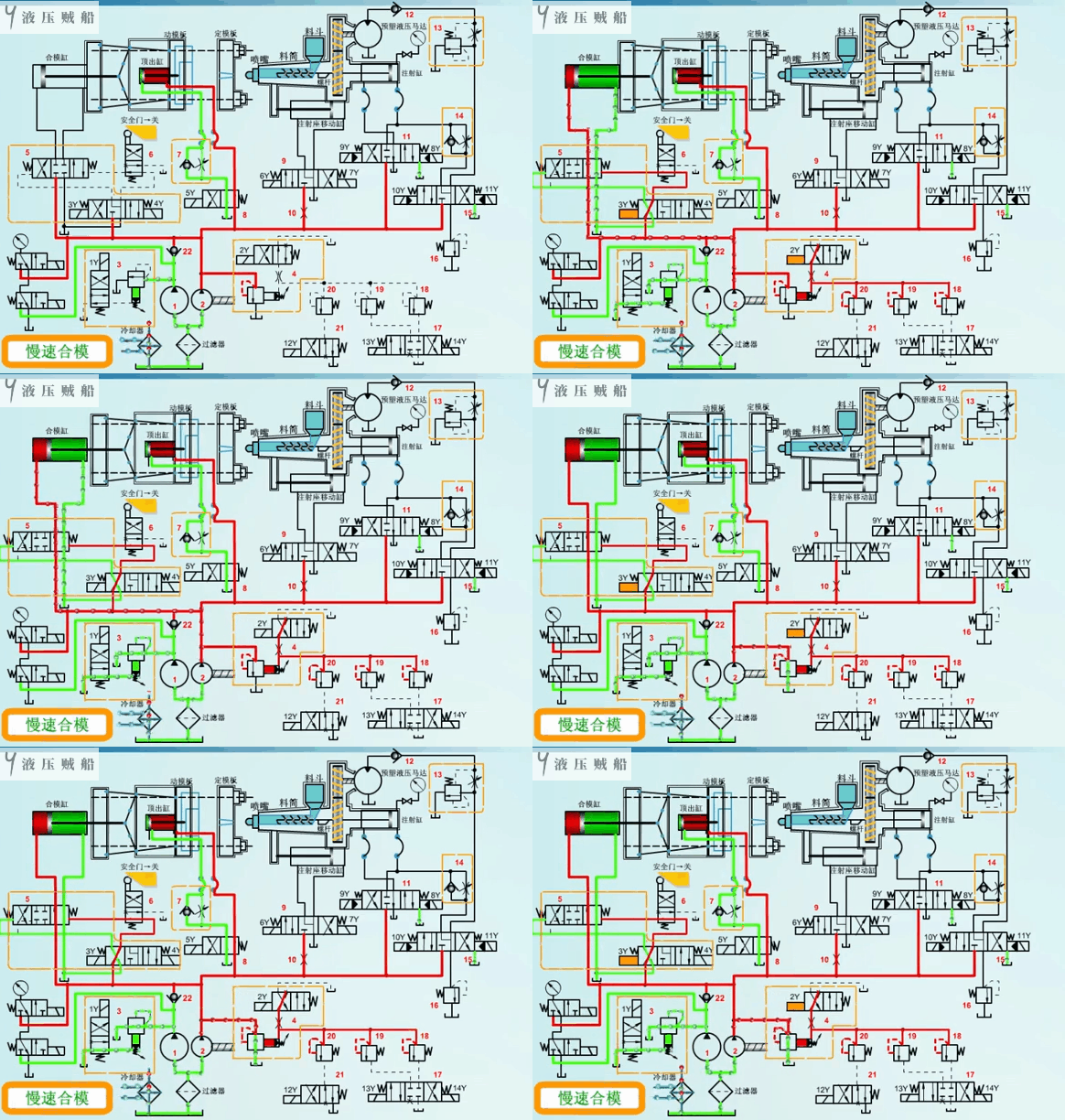
The full hydraulic drive system mainly consists of ordinary quantitative pumps or variable pumps, relief valves, throttle valves and electromagnetic directional valves and other conventional hydraulic components. Adjust the set value of the relief valve and throttle valve to meet the pressure and injection speed requirements of the injection process. Use the time relay and programmable logic controller to control the on and off of each electromagnetic switching valve. This ensures that each process cycle is carried out in an orderly manner.
Advantages and disadvantages of fully hydraulic drives
The hydraulic system structure is reliable, inexpensive, and easy to maintain. However, it can only realize switching control and at most provide a few levels of speed and pressure control. This limitation means it can no longer meet the process requirements of graded injection. In addition, when working, the relief valve remains in the overflow state. This condition results in a large amount of overflow and throttling loss, leading to significant energy loss. As a result, it is difficult for the system to meet the current requirements of complex injection molding processes.
Electro-hydraulic hybrid drive systems
Electro-hydraulic hybrid method, from the traditional valve control scheme into a pump control scheme, combining the advantages of hydraulic high power density, multi-axis control and electrical high-precision control, energy-saving excellent characteristics, quickly favoured by the market and widely promoted.
Of course, the electro-hydraulic hybrid drive system can be further subdivided into the following three types:
Proportional control systems
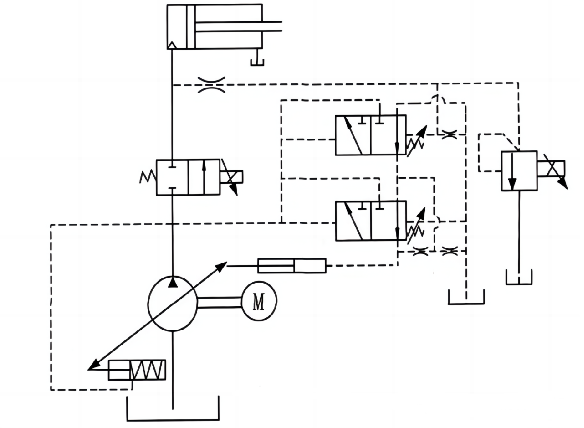
The proportional control system has the advantages of high precision, fast response, simplified system structure and easy control. Compared with servo valves, it has low cleanliness requirements for hydraulic oil and low pressure drop losses, while meeting most industrial demands. Despite the existence of certain overflow and throttling losses, it is more energy efficient than the system of quantitative pumps plus valves, and is capable of closed-loop control and improved repeatability.
Frequency control system
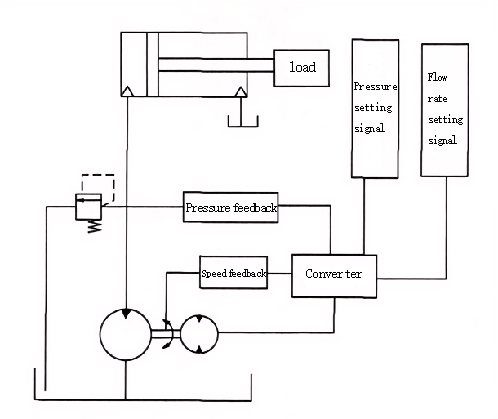
The variable frequency control system regulates motor speed by changing the power supply frequency. This adjustment changes the displacement of the dosing pump, ensuring that the flow or pressure required by the load is compatible with the system. As a result, the system eliminates essentially all overflow and throttling losses and significantly reduces the use of various hydraulic valves.
Servo control systems
Servo control system includes servo motor-driven all-electric system, servo valve system and servo motor-driven electro-hydraulic compound system. The servo-electric system has one less execution element compared to the servo-hydraulic system. This not only saves energy but also offers high precision, a wide range of injection speed adjustments, and good low-speed stability. The all-electric injection moulding machines use many servo motors. This results in high development costs and a price several times that of an ordinary injection molding machine.
All-electric servo drive system
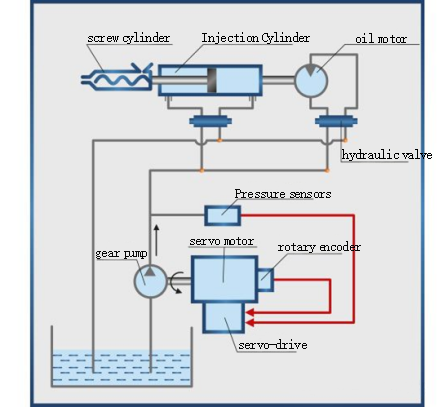
The all-electric servo drive system is mainly composed of servo motor, driver, encoder and controller. The servo motor outputs precise rotational speed and torque according to the controller’s instructions, driving the screw to perform plastic melting, injection, and other operations. The encoder detects the motor’s position and speed information in real time and feeds this back to the controller. This forms a closed-loop control, ensuring the accuracy and stability of the movement.
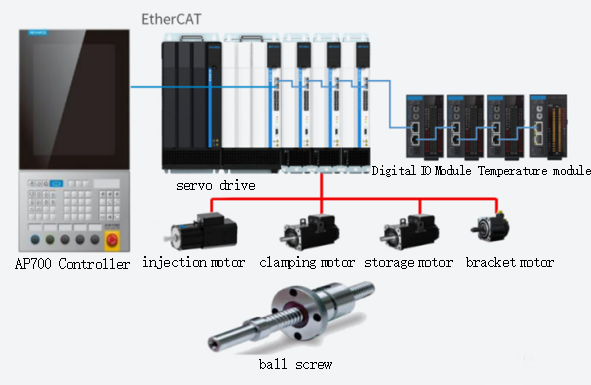
Features of the electric servo drive system include:
High precision: achieve high precision position, speed and pressure control, significantly improve the dimensional accuracy and quality consistency of injection moulded products.
High responsiveness: servo motor has the characteristic of fast response, which can quickly adjust the working state and improve the production efficiency.
Energy saving and environmental protection: no hydraulic oil leakage and energy loss, more energy saving and environmental protection.
Low maintenance cost: simple structure, reduce hydraulic oil replacement and maintenance costs, reduce overall operating costs.
Easy to operate: digital control system, friendly and intuitive operation interface, easy to grasp and use.
Summary and application
Overall, conventional hydraulic systems are reliable in structure, low in price, and easy to maintain. However, they struggle to meet the demand for high precision and high repeatability in complex injection molding processes. Electro-hydraulic hybrid systems and electric systems with high-precision control, energy-saving and fast response speed are gradually becoming popular in the market. The all-electric servo-driven system, on the other hand, has higher energy-saving effect and precision, but the cost is higher.
Industries such as electronics, automotive, and medical widely use injection molding machines. At present, China mostly uses proportional variable pump systems and variable frequency speed control systems. Meanwhile, abroad, alongside the traditional all-hydraulic drive, new transmission technologies driven entirely by electric servos have emerged. For example, all-electric injection moulding machine has high clamping force, high speed injection speed and very high cost-effective, energy-saving up to 70%. Many enterprises have introduced high-precision servo drive systems to improve product size consistency and reduce scrap rates. At the same time, they achieve significant reductions in energy consumption and production costs.
Contact Zhuo Yi Control Technology for the latest production technology!