
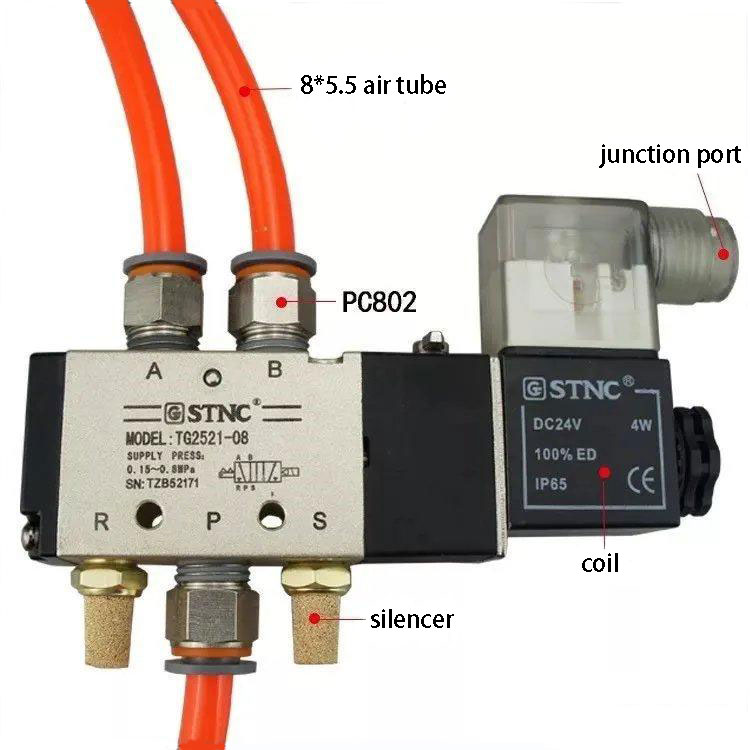
How do I troubleshoot a 2 way hydraulic solenoid valve?
The rated voltages of 2 way hydraulic solenoid valve coils are DC12V, DC24V, AC24V(50/60Hz), AC110V(50/60Hz), AC220V(50/60Hz), AC380V(50/60Hz).
Generally in the electrical design of either AC220V (no need to install switching power supply, low cost, simple lines and easy maintenance), or DC24V (commonly used safety voltage, switching power supply/solenoid valve coil are easy to maintain and replace).
Test for 2 way hydraulic solenoid valves
First to the 2 way hydraulic solenoid valve on the controlled medium (with pressure liquid, gas <air>, the pressure value of the solenoid valve for the use of the pressure range of the middle value), and then to the solenoid valve coil is energised, if the controlled medium from the on to the off or from the off to the through the state of the change, then the solenoid valve is good, otherwise it is a problem.
2 way hydraulic solenoid valve common faults are?
1. The coil is short-circuited or disconnected:
Detection method: First, use a multimeter to measure the coil’s resistance when it is on and off. If the resistance approaches zero or infinity, you can determine that the coil either short-circuits or disconnects. If the resistance measurement is normal (usually in the range of dozens of ohms), it does not necessarily mean that the coil is in good condition. For example, I once measured a solenoid valve coil with a resistance of about 50 ohms, but it did not actuate until I replaced the coil, after which everything worked normally. To perform a final test, place a small screwdriver near the metal rod of the solenoid valve coil and then energize the solenoid valve. If you feel a magnetic pull, the coil is good; otherwise, it is faulty.
Treatment: Replace the 2 way hydraulic solenoid valve coil.
2. Faulty plugs/sockets:
Failure phenomenon: If the 2 way hydraulic solenoid valve is the kind of plug / socket, there may be socket metal reed problem (I have encountered), plug wiring problems (such as the power cord to the earth wire up) and other reasons can not send power to the coil. It is best to make a habit of screwing on the set screw after you insert the plug into the socket and to screw on the set nut after you place the coil onto the spool stem.
If the solenoid valve coil plug has a light-emitting diode power indicator, you should connect the solenoid valve correctly. When the solenoid valve receives power from the DC supply, the indicator will light up. If the indicator does not light up, the connection is incorrect. Additionally, avoid switching between different voltage levels with a light-emitting diode power supply indication plug. Doing so may cause the light-emitting diode to burn out or result in short-circuiting when you switch to a lower voltage level. Alternatively, the diode may emit very weak light if you switch to a higher voltage level.
Without a power indicator, 2 way hydraulic solenoid valve coils do not need to be polarity-separated (unlike transistorised time relays with DC coil voltage and intermediate relays with DC coil voltage with diode/resistor leakage circuits connected in parallel to the coil <these intermediate relays are predominantly original Japanese ones>, which need to be polarity-separated).
Treatment: Correct wiring errors, repair or replace plugs and sockets.
3. Spool problem:
Failure phenomenon 1: in the 2 way hydraulic solenoid valve through the medium pressure is normal, press the 2 way hydraulic solenoid valve red manual button, the solenoid valve are no response (pressure medium does not appear to be on and off changes), that the spool must be bad.
Treatment: check whether the medium is a problem, such as compressed air is a lot of water (sometimes the role of oil-water separator is not very big, especially when the pipeline design is poor through to the 2 way hydraulic solenoid valve compressed air there will be a lot of water), through the liquid medium is a lot of impurities. Then clear the solenoid valve and piping in the water or impurities. If it does not work, please repair or replace the spool, or simply replace the entire solenoid valve.
Failure phenomenon 2: After checking, the coil is the original coil and coil power when the magnetic normal, but the 2 way hydraulic solenoid valve still does not act (this time, the solenoid valve manual button function is likely to be normal), indicating that the spool is bad.
Treatment: Please repair or replace the spool, or simply replace the entire solenoid valve altogether.
2 way hydraulic solenoid valve troubleshooting
2 way hydraulic solenoid valves do not work when energised
Check for poor power supply wiring → rewire and reconnect connectors
Check that the power supply voltage is within the ± operating range → adjust to the normal position range.
Whether the coil is desoldered or not → Resolder
Coil short circuit → Replace coil
Whether the working differential pressure is inappropriate → adjust the differential pressure → or replace the commensurate solenoid valve
Fluid temperature is too high → Replace the appropriate solenoid valve.
There are impurities so that the solenoid valve main spool and moving iron core stuck → cleaning, if the seal is damaged should replace the seal and install a filter
Fluid viscosity is too high, frequency is too high and life expectancy has expired → Replace the product.
2 way hydraulic solenoid valve won’t close
The seal of the main spool or iron spool is damaged → Replace the seal.
Fluid temperature, viscosity is too high → Replacement of counterpart solenoid valve
There are impurities into the solenoid valve spool or moving iron core → clean it.
Spring life expired or deformed → Replace
Throttle hole balance hole clogging → timely cleaning
Operating frequency is too high or life expectancy has expired → Change product or update product
Other cases
Internal leakage→**Check** if someone has damaged the seal and if someone has poorly assembled the spring.
External leakage → loose connection or broken seal → tighten screws or replace seal
Noise during power-on → The solid parts on the head are loose, tighten them. Voltage fluctuation is not within the allowable range, adjust the voltage. Iron core suction surface impurities or uneven, timely cleaning or replacement.
Quickly determine the 2 way hydraulic solenoid valve on-site good or bad method
Firstly check if the 2 way hydraulic solenoid valve solenoid coil is faulty?
In the DCS to the two-position valve to open or close the signal, and then see whether the solenoid valve to lose power, generally in the field to listen to the sound can be. If you can not hear, the coil must be a problem, as for the solenoid valve itself is not a problem?
If you encounter a problem with the solenoid coil, first check the wiring for false connections or short circuits. If the wiring is fine, then the problem could be a burned-out solenoid coil. Remove the wiring from the solenoid valve and use a multimeter to measure it. If you find an open circuit, the solenoid coil has burned out. Reasons are coil moisture, causing insulation is not good and magnetic leakage, resulting in excessive current in the coil and burned, so to prevent rain from entering the solenoid valve. In addition, the spring is too hard, the reaction force is too large, the number of turns of the coil is too small, the suction force is not enough can also make the coil burned.
Second, if the coil is good, it is the solenoid itself.
You can generally adjust the valve manually from position 1 to 0 to open it. If the coil can open the valve, it is likely that the coil is faulty, and you should replace it. If the solenoid valve cannot open, check whether the spool is stuck or if particles are blocking it. Clean the valve with CCL4 if possible, but if you’re on-site and CCL4 isn’t available, you can use petrol. If there is no water, you can use it to clean the solenoid valve.
Finally, use field instrumentation gas to blow it dry. After cleaning, you can use on-site instrumentation gas to blow dry, when you dismantle it, be sure to remember the order of parts, if you do not pay attention to it, it is very easy to make a mistake when installing, the order of remembering the wrong even if you clean the solenoid valve, even if the solenoid valve is already through it is still not open!
Contact Zhuo Yi Control Technology for the latest production technology!


