
The structure, graphic symbols and application of threaded cartridge valves Valve block system diagram is shown in Figure 26-161. This type of valve has many advantages for engineering applications, so it is gradually becoming the mainstream valve in the development of hydraulic valves.
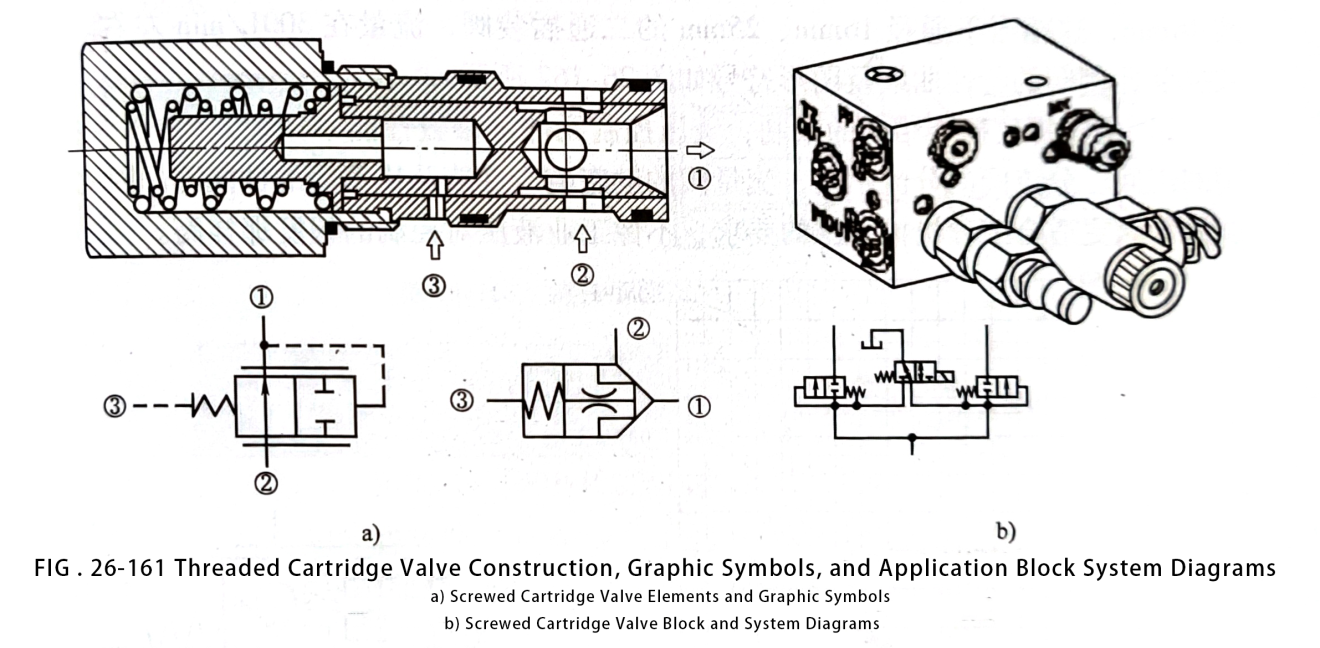
Threaded cartridge valves have the following advantages.
1) to achieve zero external leakage, change the hydraulic easy environmental pollution, reduce the efficiency of the end.
2) When integrated with other valves, the threaded cartridge valve offers a minimum volume and space-saving advantage. This design aligns with the requirements of hydraulic devices used in construction machinery and vehicles.
3) Threaded cartridge valve and its valve block with CNC machine tools, cost reduction, batch size, with other valve types of competitive advantage.
4) The threaded cartridge valve provides diversification, combination, and performance integration for hydraulic valves. It introduces new development approaches that enrich the functionality of hydraulic valves and expand their application capacity. As a result, it is increasingly replacing conventional hydraulic components, such as the plate stacked valve type.
5) threaded cartridge valve due to get rid of the casting of the valve body, the use of CNC machining. Valve manufacturing is easy, structural innovation is more convenient.
6) In the design process, one can apply group technology, organizing the production of parts into groups. This approach requires a higher level of valve manufacturing and organizational management.
The threaded cartridge valve has more structural characteristics compared to the existing plate and stacked valves. Its varieties and structure are more complex. This requires a higher level of manufacturing and management. These further enable the production of large quantities of parts, the cost of reducing the space to increase.
7) Threaded cartridge valves are very flexible in their composition with other components and systems. They promote the development of new components and hydraulic host systems, facilitating the creation of new products. This flexibility also supports the advancement of technology and the development of hydraulic patent technology.
In summary, threaded cartridge valves have the advantages of zero leakage, light weight, small size, easy to integrate, easy to synthesise, low cost, easy to install, greener and easy to develop.
The limitations and problems of threaded cartridge valves are as follows.
1) Due to the limitations of thread strength and tightening torque (500N-m), the diameter of threaded cartridge valves can only reach 48mm, which is equivalent to two-way cartridge valves with a through diameter of 16mm and 25mm, and a flow rate of about 300L/min. The characteristic curve and graphical symbols of threaded cartridge proportional valves are shown in Figure 26-162.
2) Due to the limitations of the threaded cartridge structure, the performance of hydraulic control components and other parameters is not as good as the plate valve, such as the hysteresis of the relief valve, the diverter valve diverting accuracy, the dynamic response of the flow valve and the performance of the proportional valve, etc. Therefore, the threaded cartridge valve is more suitable for the valve. Therefore, the threaded cartridge valve is more suitable for engineering machinery hydraulic requirements, unlike industrial hydraulics on the control of high precision.

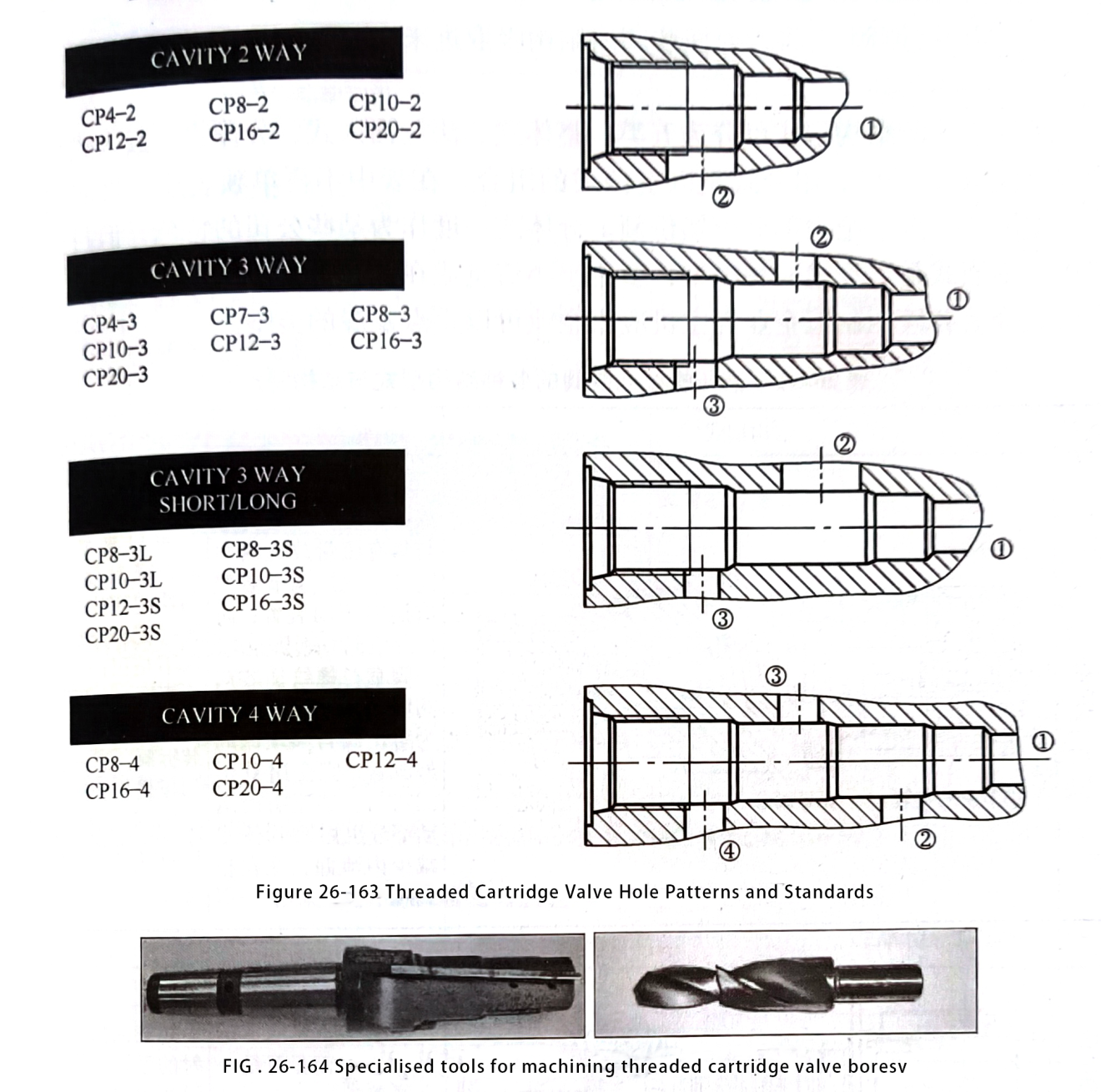
3) Hole type standard (see Figure 26-163) is still difficult to unify. Despite the promulgation of the IS0 standard, the companies used in the hole type is still popular in the following versions: IS0 hole type, European standards, SUN hole type standard and NFPA American standards. China has also promulgated a national standard in 2004, which is in line with the IS0 hole type standard.
4) The company’s solenoid coil is not uniform, so that the specifications of a variety of complex, easy to increase the amount of user spare parts.
5) The integrated block design has stronger technical requirements compared to the plate valve. Consequently, the user’s design level needs to be relatively high.
6) The hole type processing requires special tools, which increases costs. Additionally, the processing demands are relatively higher compared to those for plate valves (see Figure 26-164).
7) Due to the increasing number of newly developed valve types for cartridge valves, the technology lacks sufficient promotion. As a result, training and exchanges are needed to realize the potential of threaded cartridge valves.
Contact Zhuo Yi Control Technology for the latest production technology!


