
3 way 2 position hydraulic solenoid valve is an industrial equipment controlled by electromagnetism, is used to control the fluid automation basic components, belongs to the actuator, and is not limited to hydraulics, pneumatics. Used in industrial control systems to adjust the direction, flow, speed and other parameters of the medium. 3 way 2 position hydraulic solenoid valve can be used with different circuits to achieve the desired control, control precision and flexibility can be guaranteed. There are many kinds of solenoid valves, different 3 way 2 position hydraulic solenoid valve play different roles in different positions of the control system.
3 way 2 position hydraulic solenoid valve are divided into three main categories from the principle:
- direct-acting solenoid valve;
- step-by-step direct-acting solenoid valve;
- pilot operated solenoid valve.
Solenoid valves can be divided into six sub-branches based on differences in valve structure, material, and principle. These sub-branches are:
1. Direct diaphragm structure
2. Step-by-step direct diaphragm structure
3. Pilot diaphragm structure
4. Direct piston structure
5. Step-by-step direct piston structure
6. Pilot piston structure
Solenoid valves can be classified according to their function. These classifications include water solenoid valves, steam solenoid valves, refrigeration solenoid valves, low temperature solenoid valves, and gas solenoid valves, among others.
Direct-acting solenoid valve:
Principle: When energized, the solenoid coil generates an electromagnetic force that lifts the closing piece from the valve seat, causing the valve to open. When de-energized, the electromagnetic force disappears, and the spring presses the closing piece back onto the valve seat, causing the valve to close.
Characteristics: in a vacuum, negative pressure, zero pressure can work properly, but the diameter is generally not more than 25mm.
Step-by-step direct-acting solenoid valve:
Principle: It is a combination of direct-acting and pilot-operated principles. When there is no pressure difference between the inlet and outlet, and after power is turned on, the electromagnetic force directly lifts the pilot valve. This action sequentially lifts the main valve’s closure piece upwards, causing the valve to open.
When the pressure difference between the inlet and outlet starts, and power is applied, the electromagnetic force acts on the pilot small valve. This causes the pressure in the main valve’s lower chamber to rise, while the pressure in the upper chamber falls. As a result, the pressure difference pushes the main valve upwards.
In the event of a power failure, the pilot valve relies on spring force or medium pressure to push the closing member downward, which results in the valve closing.
Characteristics: in zero differential pressure or vacuum, high pressure can also be reliable action, but the power is larger, the requirement must be installed horizontally.
Pilot operated solenoid valve – pipeline direct application:
Principle:
When energized, the electromagnetic force opens the pilot hole, causing the pressure in the upper chamber to drop rapidly. This creates a low pressure difference around the shut-off parts. The fluid pressure then pushes the closing parts upward, causing the valve to open.
In the event of a power failure, the spring force closes the pilot hole. The inlet pressure then flows through the bypass hole, rapidly creating a low pressure difference around the shut-off parts. This fluid pressure pushes the closing parts downward, closing the valve.
Characteristics: the upper limit of the fluid pressure range is high, can be arbitrarily installed (need to be customised) but must meet the conditions of the fluid differential pressure.
Pilot Operated Solenoid Valves – Pneumatic/Hydraulic Actuated Category:
Solenoid valves can be classified according to their function. These classifications include water solenoid valves and steam solenoid valves. Other classifications are refrigeration solenoid valves, low temperature solenoid valves, and gas solenoid valves, among others. When the coil is energised or de-energised, the operation of the core will cause the fluid to pass through the valve body or be cut off to change the direction of the fluid. We commonly used in the production of solenoid valves are two-position three-way, two-position five-way and so on. The meaning of the two here: for the solenoid valve is charged and de-energised, for the control of the valve is open and closed.
Basic structure and principle of action:

Pilot operated pneumatic/hydraulic drive class highlights:
Pilot operated solenoid valves pneumatic / hydraulic drive class conventional applications:
Classification: this type of solenoid valve belongs to the actuator, but the conventional industrial occasions to use generally there are also secondary actuators, that is, valves/cylinders.
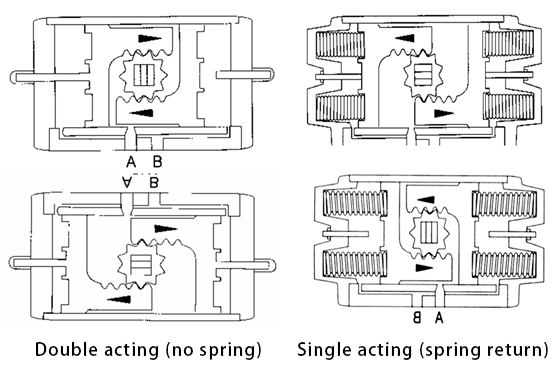
You generally use single-acting valves for two-position three-way solenoid valves, and these are typically single-potential.
You generally use double-acting valves for two-position five-way solenoid valves, and you can choose between single-potential and double-potential options.
Cylinder generally use three five-way solenoid valve, double potential.
Simply put: In a single-acting valve, external forces can open or close the valve, and when you withdraw these external forces, the valve returns to its original state. In a double-acting valve, external forces can open or close the valve, and when you withdraw these external forces, the valve remains in its current position.
Cylinder transverse actuator:
1. About mid-position stop
In the case of intermediate stop of the cylinder piston with a three-position centre-seal type or a medium-pressure type directional valve, it is difficult to achieve a correct and precise positional stop because the air is compressible. In addition, since you cannot guarantee that the valve and cylinder will be free of leakage, avoid holding them in the middle stop position for a long time. If you want to maintain the stop position for a long time, you should use other methods.
2. Influence of back pressure on valve assembly
When you use valves in assemblies, pay attention to the potential malfunction of the actuator caused by back pressure. This is especially important in the case of three-position medium-drain directional valves and single-acting cylinder actuators. If you are concerned about this kind of malfunction, you must feed and exhaust the air separately.
3. Residual pressure relief
A residual pressure relief function should be provided in consideration of the need for maintenance and inspection. In particular, if you use a three-position center-seal valve, make sure to release the residual pressure between the directional valve and the cylinder.
4、About the instantaneous energising and ventilating of dual control valves
For a two-position five-way dual electric control valve or a conventional dual electric (gas) control valve with memory function (excluding three-position valves), during instantaneous energization, the energization time should be more than 0.1 seconds. This ensures that the valve has fully reversed.
5、About the use of air supply pressure
For internal pilot-operated valves, you need to consider the minimum operating pressure requirements. However, direct-acting or external pilot-operated types are not subject to these minimum operating pressure requirements.
6, solenoid valve if installed in the control cabinet, power long time, pay attention to the control cabinet ventilation, heat dissipation.
7, solenoid valve wiring connection:
(1) on the polarity: DC specifications of the solenoid valve come with a polarity indicator. When wiring, you should pay attention to the positive and negative poles. If the connections are reversed, the indicator will not light up. However, the valve can still function.
(2) Applied voltage: solenoid valve before connecting the power to carefully check the voltage parameters on the coil, so as not to cause poor valve action or coil burnt.
8, the installation of the solenoid valve
Although you can install the solenoid valve in any direction, you need to keep certain considerations in mind. Vibration of the device or the flow of condensate, oil, and other liquids to the coil part of the solenoid valve can cause damage. Therefore, you need to pay attention during installation to avoid these issues.
1) Countermeasures against vibration
Install the solenoid valve so that the direction of vibration is at right angles to the direction of action (axial) of the solenoid valve’s slide column.
2) To prevent condensate, oil, etc. from flowing into the coil of the solenoid valve, it is best to install the coil facing up or sideways. Installation illustration:

(3) Do not throttle the inlet of an internal pilot-operated solenoid valve to prevent misoperation when the pressure drop is too large during commutation.
4) Install the directional valve as close to the cylinder as possible: firstly, to reduce air consumption, and secondly, for fast response.
5)Insert the piping securely to the bottom and confirm that you cannot pull it out before using it.
(6) When installing, please note that the arrow on the valve body should be consistent with the medium flow direction.
(7) Ensure that the solenoid valve operates normally within a power supply voltage range of ±10% from the rated voltage.
8) solenoid valve installation, there shall be no reverse differential pressure in the pipeline. You need to energize it several times to ensure it reaches the correct temperature before officially putting it into use.
(9) You should thoroughly clean the solenoid valve before installing the pipeline. Passed into the medium should be free of impurities. Valve before the installation of filters;
(10) When the solenoid valve fails or needs cleaning, you should install a bypass device to ensure that the system continues to operate.
Solenoid valve use maintenance/use environment:
1、Use dry compressed air inside the piping to prevent the occurrence of water droplets.
2、Don’t use in the environment with corrosive gas, chemicals, seawater, water, water vapour or the place with the above substances.
3、Do not use solenoid valves in places with explosive gases. Pay attention to explosion-proof requirements.
4, If heat sources are around the place, shield the equipment from radiant heat.
5、Don’t use in the environment with strong magnetic field. It may cause inoperative or misoperation.
6, You should avoid energizing both ends of a dual-coil solenoid valve at the same time. Therefore, you should add an interlock circuit in the design of the electrical circuit.
Solenoid valve failure and troubleshooting:
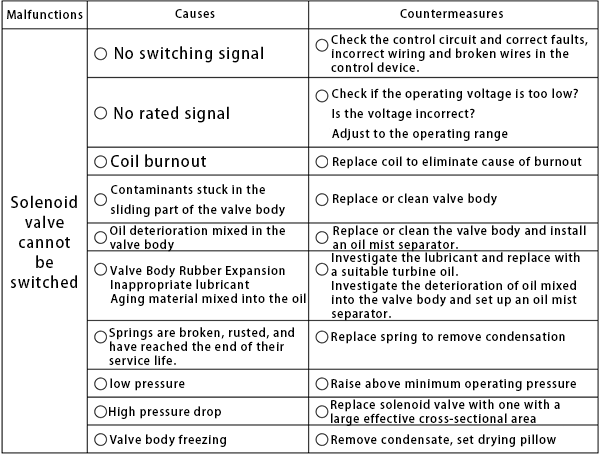
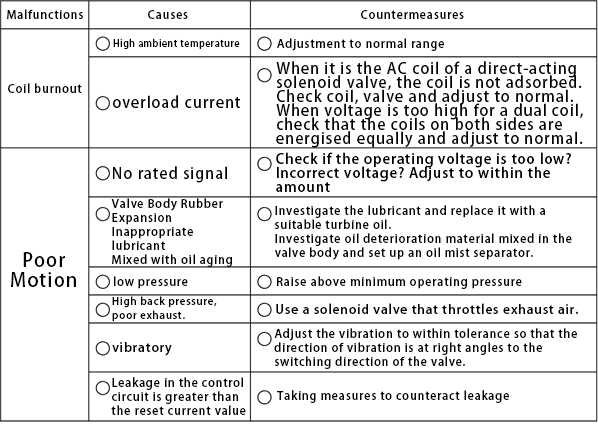
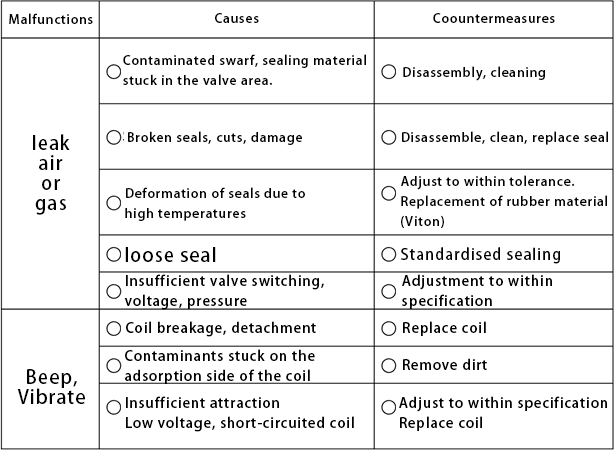
Solenoid valve common fault for the solenoid valve does not operate, should be investigated from the following aspects:
1, emergency treatment, the coil on the manual button from the normal operation of the ‘0’ position to ‘1’ position, so that the valve open.
2, When dealing with a switching system solenoid valve failure, choose the appropriate time to address it. For example, if the solenoid valve loses power, handle the situation accordingly. If you do not complete a switching gap, pause the switching system and address the processing issue.
Common fault level general treatment method is shown in the following table:
Selection:
1, according to the pipeline parameters to choose: diameter specifications (i.e. DN), interface mode.
2, according to the fluid parameters selection of solenoid valve: material, temperature group.
(1) corrosive fluid: For corrosion-resistant applications, it is appropriate to use a solenoid valve made of all stainless steel. For edible ultra-clean fluids, it is appropriate to use a solenoid valve made of food-grade stainless steel material.
(2) high temperature fluid: Choose high-temperature resistant electrical materials and sealing materials for the solenoid valve. Also, select the type of piston structure.
(3) fluid state: For gases, liquids, or mixed states, especially when the diameter is greater than DN25, you must make the distinction.
(4) fluid viscosity: Usually, for fluids with a viscosity below 50 cSt, a solenoid valve can be selected arbitrarily. If the viscosity exceeds this value, it is necessary to choose a high viscosity solenoid valve.
3, according to the pressure parameters to choose the solenoid valve: principle and structure varieties
(1) nominal pressure: the meaning of this parameter and other general valves is the same, is based on the nominal pressure of the pipeline;
(2) working pressure: If the working pressure is low, you must choose a direct-acting or step-by-step direct-acting principle. For a minimum working pressure difference of 0.04 MPa or more, you can select direct-acting, step-by-step direct-acting, or pilot-operated types.
4, electrical selection: voltage specifications should try to prioritise the selection of AC220V, DC24 is more convenient.
5, Choose between normally closed, normally open, or continuously energized types based on the duration of time.
(1) When you need to keep the solenoid valve open for a long time, and the duration exceeds the closing time, choose a normally open type.
(2) If the opening time is short or the opening and closing time is not much, then choose the normally closed type;
(3) For safety protection conditions, such as furnace and kiln flame monitoring, you cannot choose a normally open type. Instead, you should select a long-time energized type.
6, according to the environmental requirements of the choice of auxiliary functions: explosion-proof, non-return, manual, waterproof fog, water, diving.
Contact Zhuo Yi Control Technology for the latest production technology!


