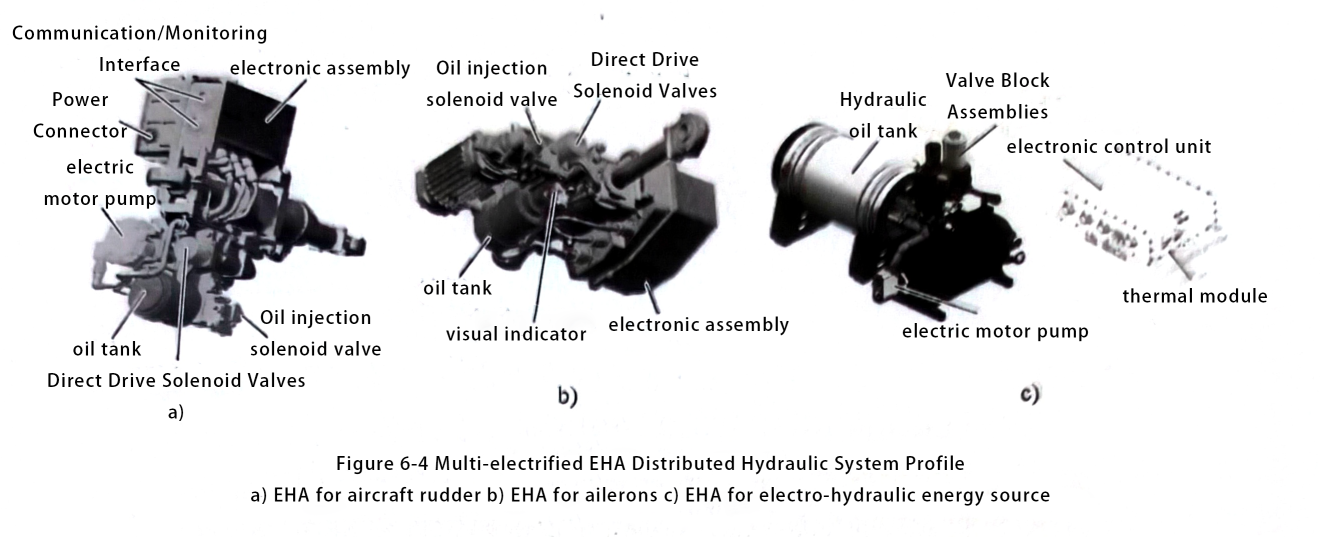
With the development of multi-electronic technology in aircraft, the concept of hydraulic distributed system is also valued and developed in various application fields of hydraulics, and forms a new technical development direction with the technology of light weight and intelligence. One of the typical forms of distributed systems is the EHA, whose structural type can be referred to as shown in Fig. 6-4 of the multi-electrification EHA distributed hydraulic system profile.
Although aeronautical multitronics drive distributed systems, traditional hydraulics has also used this approach to varying extents. For example, compact miniature power stations and hydraulic mounts exemplify this usage. Now, combining this approach with microprocessor control and 3D printing technology has led to significant advancements and improvements in the technology and products.
Differences and similarities between the installation and commissioning of distributed hydraulic systems and conventional hydraulic systems:
1) Centralised hydraulic systems feature a hydraulic power station consisting of a tank and a pump. This power station acts as a centralised energy source and uses hydraulic valves to control the various actuators, such as hydraulic cylinders or hydraulic motors. In distributed hydraulic systems, an actuator comes equipped with a hydraulic power station and corresponding control valves, forming an integrated unit that includes the actuator itself. The installation of a hydraulic system is therefore basically the same for centralised and distributed hydraulic systems. Only distributed hydraulic system is very compact, small size, relatively easy to transport. Currently distributed hydraulic system power is relatively small, generally around 10kW, the power in a few kilowatts ~ tens of kilowatts.
2) Centralized hydraulic systems typically use PLCs for electronic control. They can include logic control solenoids and analog control for proportional valves. You can either separate or integrate the proportional valve control amplifier board. In the distributed hydraulic system, the control electronic components integrate on the EHA, as shown in Figure 6-4. Network communication completes the required control.
3) Multi-electronic EHAs have their own electronic components. They use microprocessors for computing and control. As a result, they can implement the complex functions required by the device itself through software programming. These functions are not available in centralized hydraulic systems. The commissioning of the EHA involves bus programming and microprocessor programming. These tasks often exceed the technology required for conventional hydraulic systems. Therefore, they require a high level of skill from the engineer.
Contact Zhuo Yi Control Technology for the latest production technology!