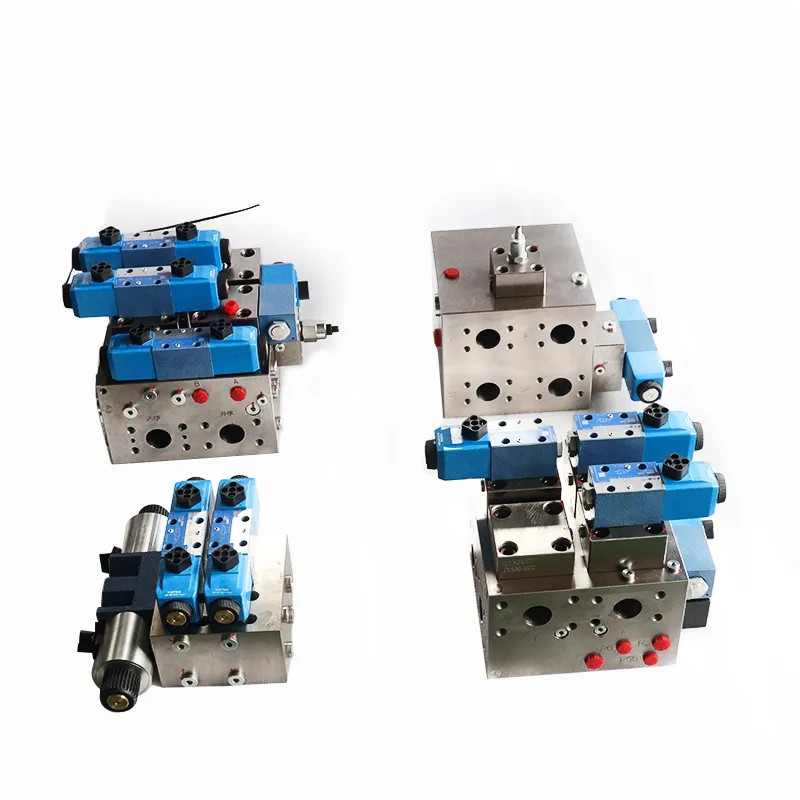
1、Relationship between diameter and flow rate
The diameter of a threaded cartridge valve is quite different from the diameter of other types of valves. In tubular, plate, stacked, and two-way cartridge valves, the diameter is related to the diameter of the inlet and outlet ports. In contrast, for threaded cartridge valves, the diameter is not directly related to the size of the ports. Instead, it is related to the size of the mounting threads of the threaded cartridge valve. Therefore, the diameter of the threads of the threaded cartridge valve is the nominal diameter of the threaded cartridge valve (see Table 26-92).
| Table 26-92 Threaded Cartridge Valve Bore vs. Flow Rate (\(\Delta p = 0.7\sim 1.4 MPa\)) | |||||||
| (unit:L/min) | |||||||
| thoroughfare | Actual valve male thread size | Flow rate (check valve) | Flow rate (relief valve) | Flow rate (throttle) | Flow rate (directional valve) | Flow rate (logic valve) | |
| two-position tee | three-position four-way | ||||||
| C-04 | 7/16-20UNF-2B | 3 | |||||
| C-07 | 5/8-18UNF-2B | 50 | 50 | ||||
| C-08 | 3/4-16UNF-2B | 8~80 | 1.1~80 | 15 | 8~35 | 6~10 | |
| C-10 | 7/8-14UNF-2B | 11~115 | 40~120 | 23~45 | 27~80 | 15~24 | 40~50 |
| C-12 | 1-1/16-12UN-2B | 90~190 | 75~190 | 45~75 | 30~115 | 40~55 | 40~160 |
| C-16 | 1-5/16-12UN-2B | 150~210 | 65~150 | 130 | 114~190 | ||
| C-20 | 1-5/8-12UN-2B | 120~380 | 340 | 230 | 200~340 | ||
| 42 | M48*2-6H | 640 | 400~800 | 0.8~480 | 480 | ||
2、Functional features of threaded cartridge relief valve
(1) threaded cartridge relief valve features: threaded cartridge relief valve action principle of direct-acting, pilot-operated and differential, differential is not the plate valve. Threaded cartridge relief valves and plate valves compared to the characteristics of the function of Table 26-93.
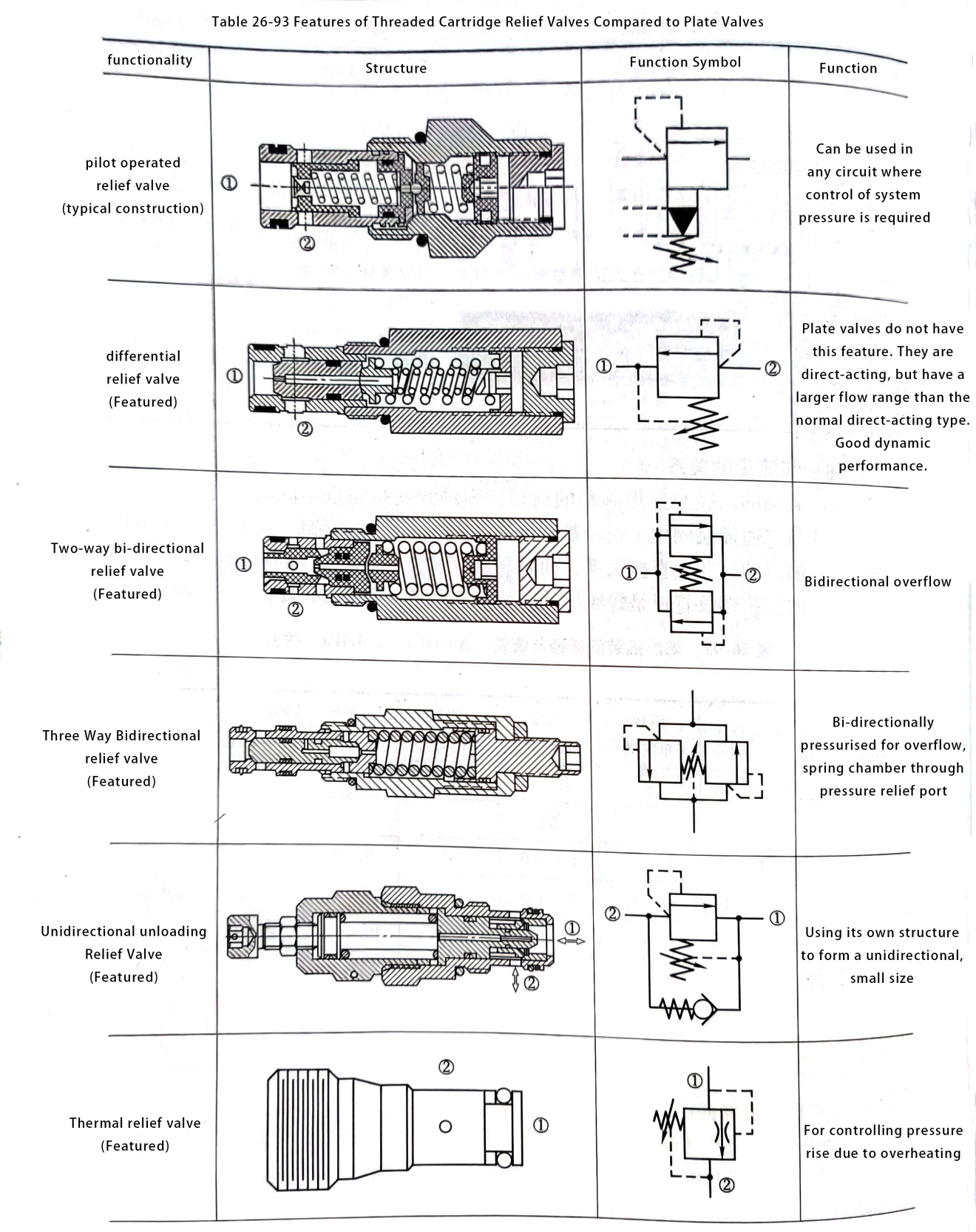
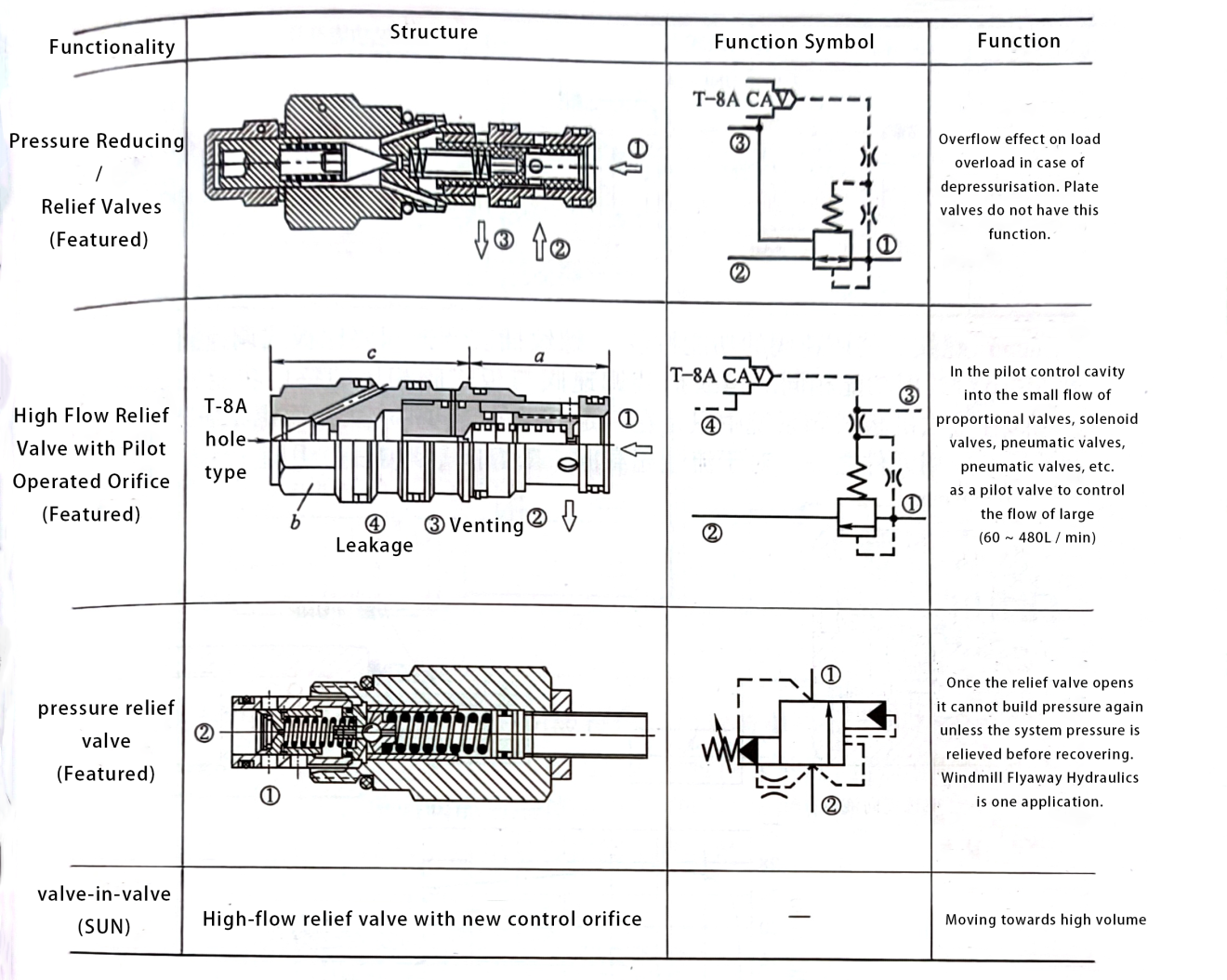
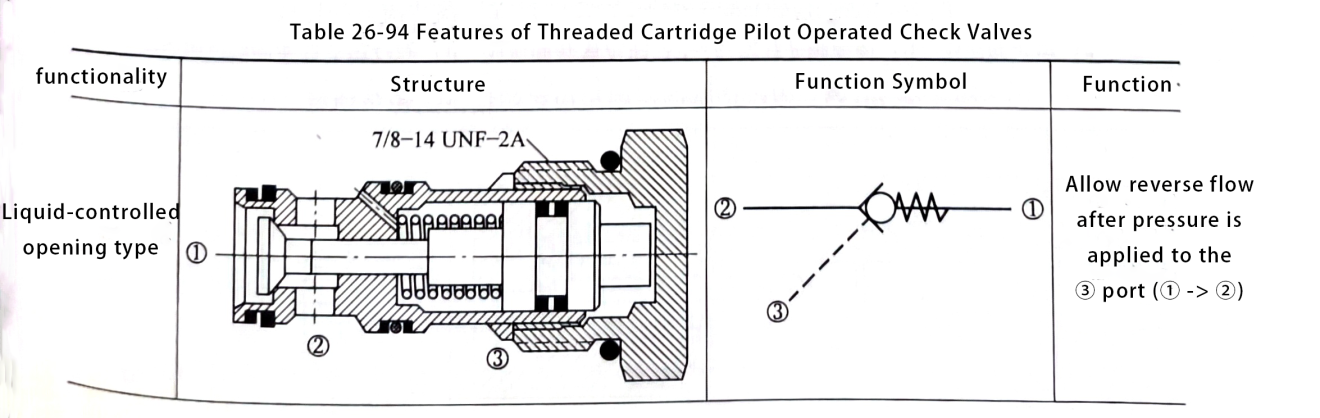
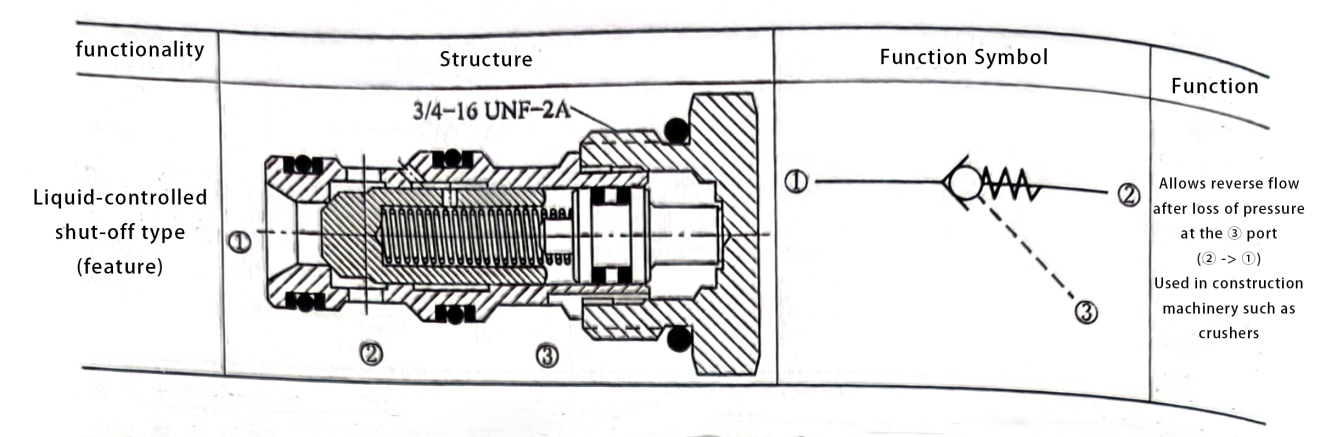
(2) Threaded Cartridge Pilot Operated Check Valve Functional Characteristics: The threaded cartridge pilot-operated check valve falls under the category of load control valves. Its basic function is to prevent leakage of the spool caused by the load produced by its front directional valve. Hydraulic control must achieve the valve’s opening. You can use it as a two-way switching valve, a pressure maintaining valve, a support valve for vertical hydraulic cylinders, or a hydraulic lock. See Table 26-94 for features of threaded cartridge pilot operated check valves.
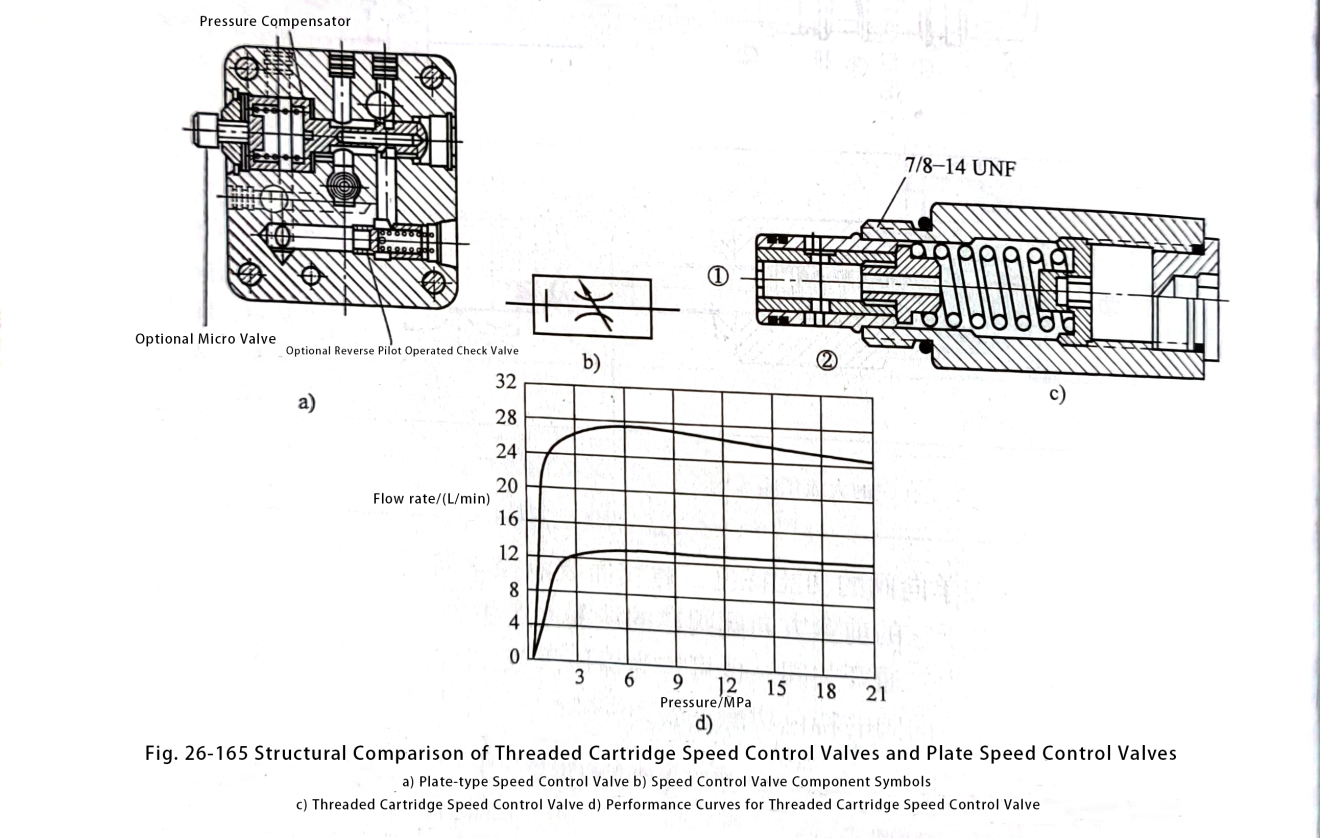
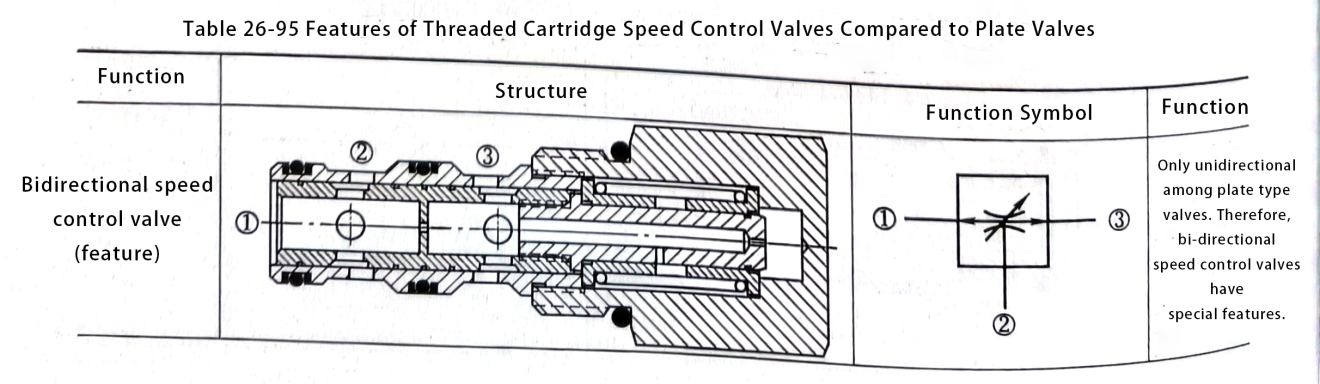
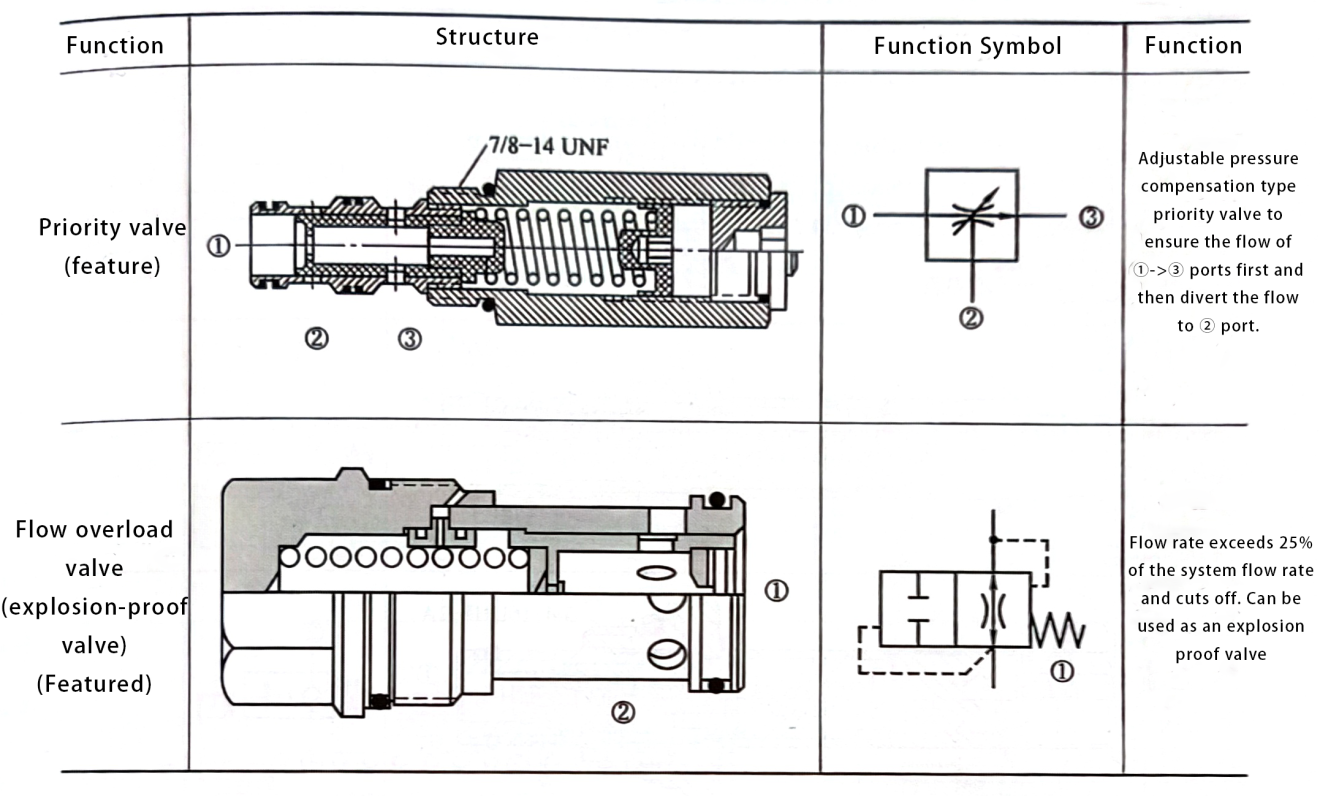
(3) Functional Features of Threaded Cartridge Speed Control Valves: Threaded cartridge speed control valves are simpler than plate speed control valves (see Figure 26-165), but have the same function. The features of threaded cartridge speed control valves compared to plate valves are shown in Table 26-95. In the past, engineers used priority valves only for the steering of traveling machines. However, today, threaded cartridge priority valves have become standard application components. For flow overload valves, explosion-proof valves are one of the uses.
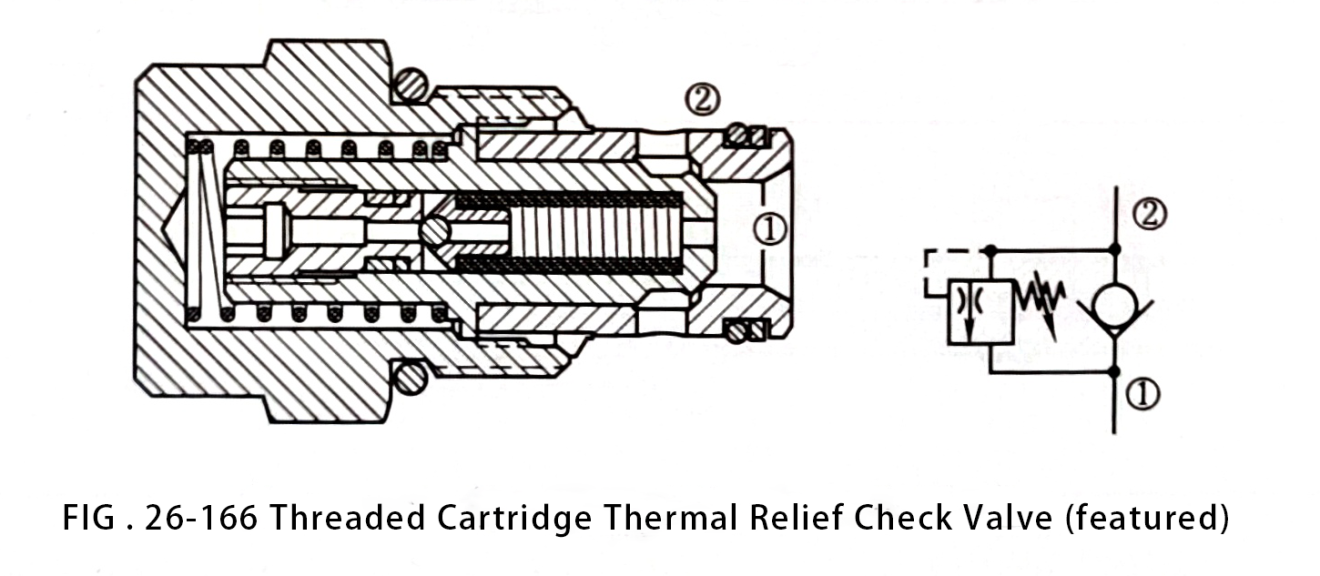
(4) Threaded cartridge thermal relief check valves share the typical requirement of nearly zero internal leakage. However, when a hydraulic cylinder with a large cavity experiences a rise in oil temperature, the pressure can increase significantly. In such cases, the check valve can release some of the expanded oil pressure. Thermal relief check valves to solve this problem (see Figure 26-166), which is not the plate valve.
(5) Threaded cartridge two-position two-way and two-position three-way solenoid valve function features In the plate electromagnetic directional valve only two-position four-way and three-position four-way. When designers need the functions of two-position two-way and two-position three-way valves, they generally use a two-position four-way valve instead. They simply need to plug one of the oil ports if necessary. Because in the plate solenoid valve are used in the slide valve type, so the internal leakage is unavoidable. If you need a valve with no leakage, you will find that the electromagnetic ball valve is much more expensive than the ordinary solenoid valve. As a result, the application of the ball valve is limited.
Threaded cartridge 2-way and 3-way solenoid valves support a wide range of applications and benefit system design, system safety, and cost. Table 26-96 lists the features of threaded cartridge 2-way and 3-way solenoid valves.
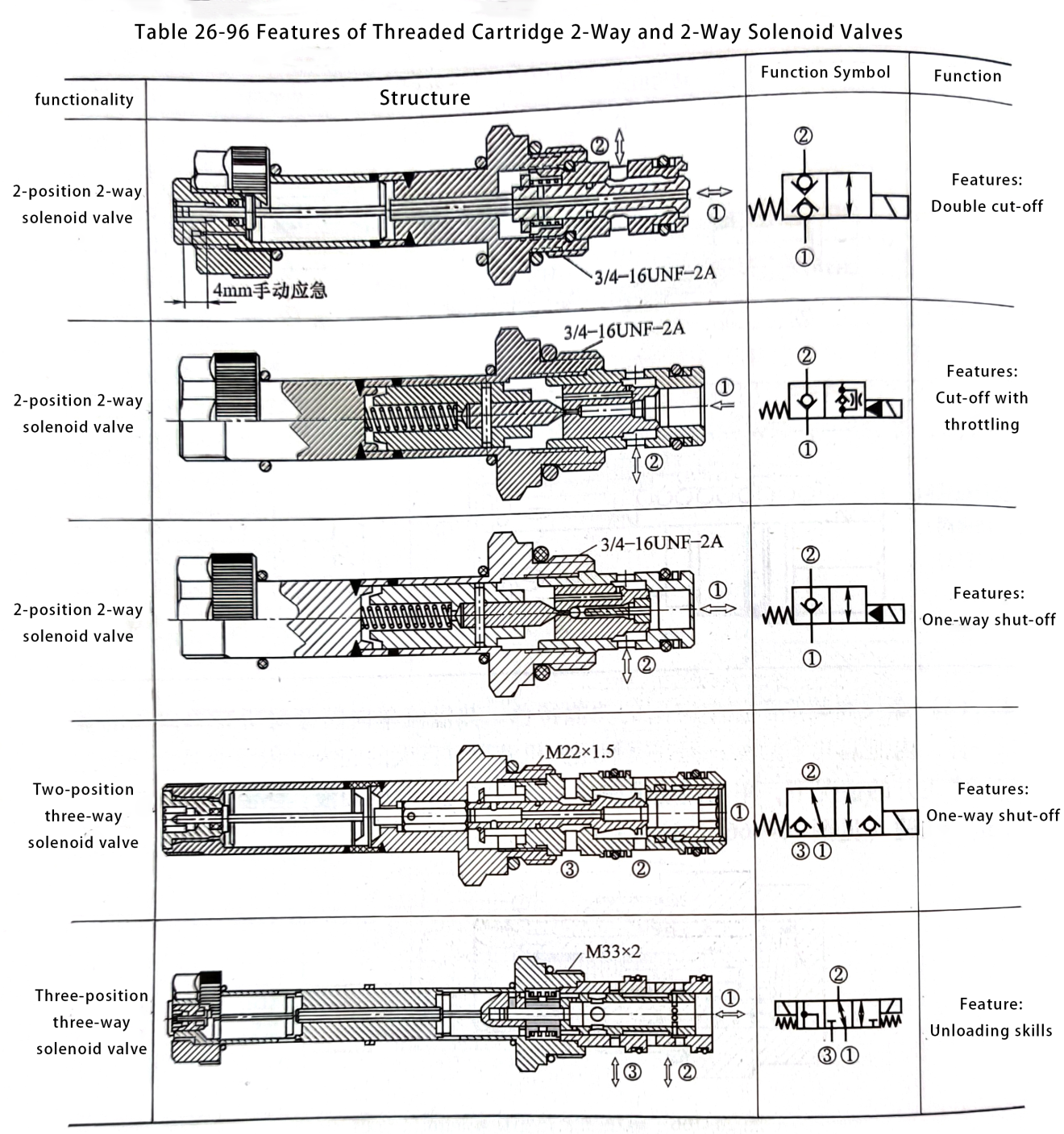
Overall, the threaded cartridge solenoid valves and plate valves compared only in the two-position two-way and two-position three-way has obvious characteristics and advantages. In the system design for energy saving and pressure control, there is still a considerable gap. This gap exists in the two-position four-way and three-position four-way configurations. This gap includes the median function. Currently, threaded cartridge valves do not reach the level of plate valves. From the perspective of future development, threaded cartridge valves in this regard there is still much room for improvement.
(6) Threaded Cartridge Logic Valves Threaded cartridge logic valves have the characteristics of both poppet valves and sometimes two-way cartridge valves. However, there are differences in structure and function with these valves. The spool structure of 2-way cartridge valves is divided into two types: cone valve pressure type and slide valve type, each with different area ratios. Threaded cartridge logic valves have four structures. These include the cone valve normally closed direction type, the slide valve normally closed pressure type, and the cone valve normally closed pressure type. Additionally, they include the slide valve priority type, which SUN patented.
Threaded cartridge logic valve applications are more flexible and broad. They can include the composition of load-sensitive systems, among others. A threaded cartridge logic valve does not necessarily have only three ports; it can have four or more ports. This feature is completely different from the two-way cartridge valve. Additionally, a threaded cartridge logic valve can be designed as a pilot valve with a “valve in the valve” structure. This design makes it unique. This is a unique design among threaded cartridge logic valves. See Table 26-97 for features of threaded cartridge logic valves.
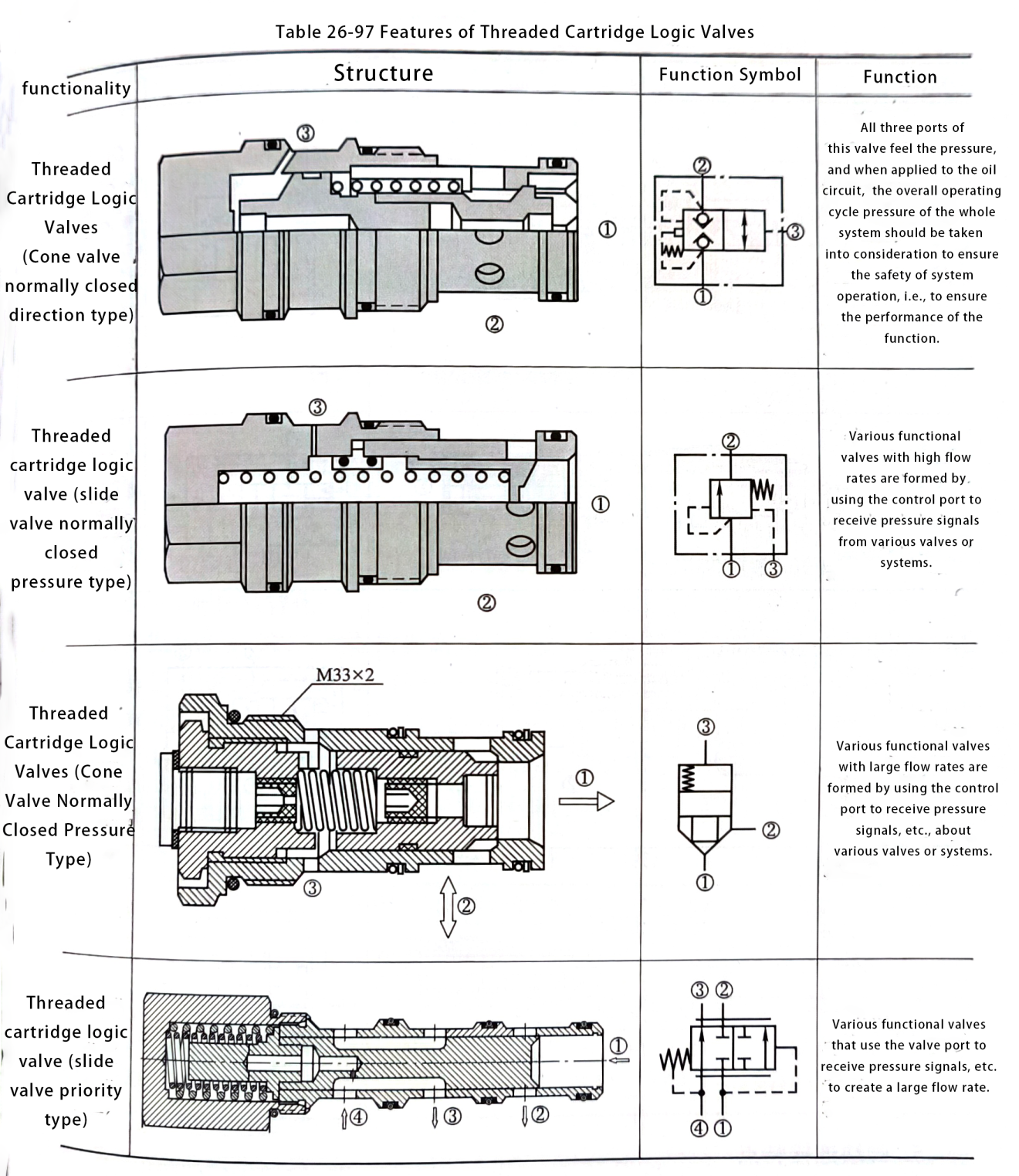
The structure, function, and application of threaded cartridge logic valves are richer and more diverse compared to traditional valves. Additionally, there is more room for development in this area.
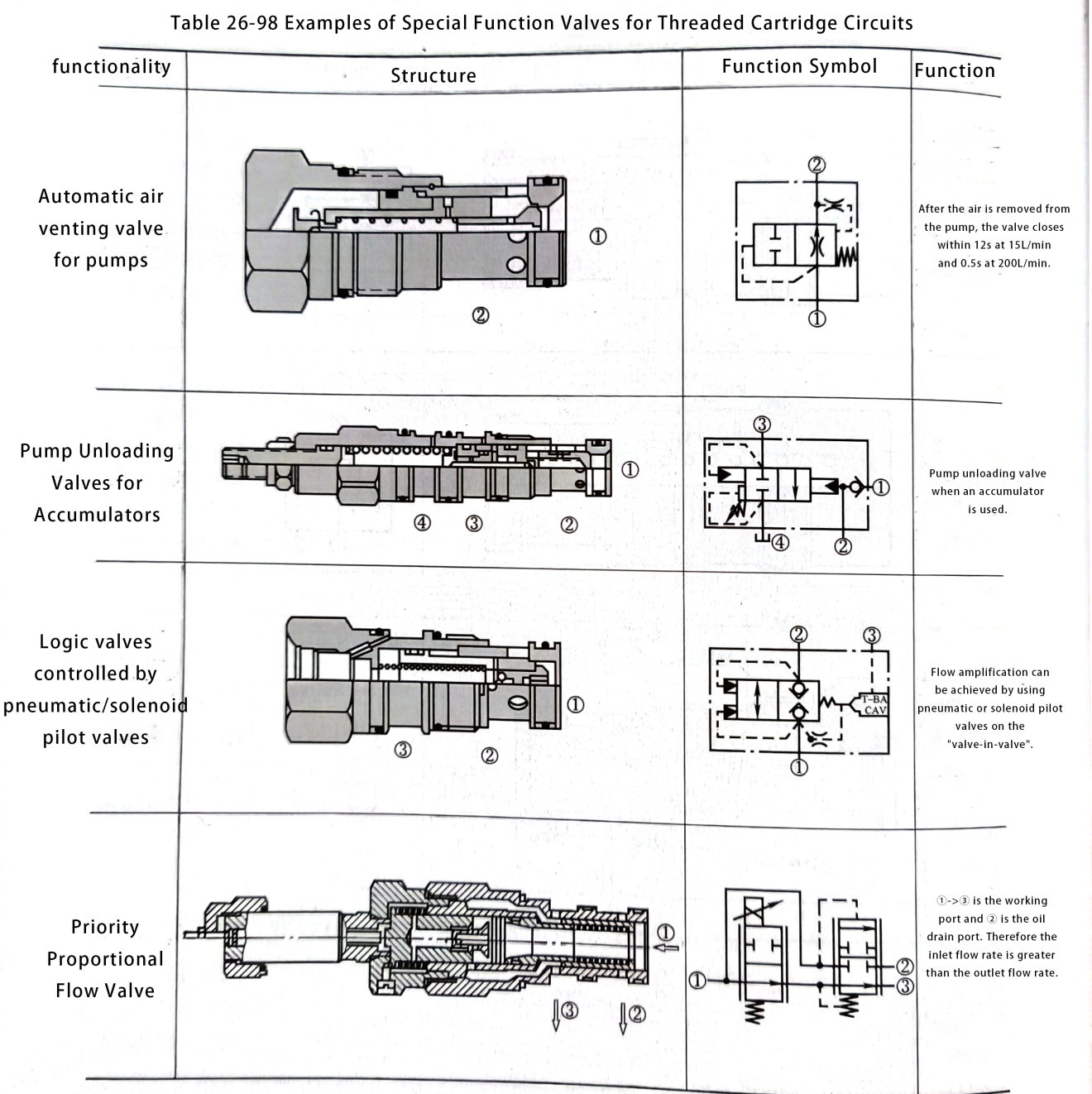
(7) Threaded cartridge circuit special function valves come in two types. The first type is in the form of a single element. Manufacturers form the second type by combining multiple elements into a valve block. Table 26-98 lists various typical examples of these valves. Various manufacturers have designed these valves, and they are highly developable. They cater to specific applications or user requirements.
3、 Valve block connection characteristics
Threaded cartridge valve elements connect to the valve block with threads. This connection forms a threaded cartridge valve block. The threaded cartridge valve block is used in the system. A threaded cartridge valve block in the system can use various connection methods. However, it typically falls into one of the following types: tube, stacked, plate, flange, or threaded cartridge valve block. These can be either company standard or customized.
Contact Zhuo Yi Control Technology for the latest production technology!