
Hydraulic hoses are designed to withstand much higher pressures than would be expected during routine operation, everyone will agree. If your machine operates in the typical 3,000 psi range, a hydraulic hose designed to burst at 3,100 psi will give you little peace of mind. The slightest pressure spike can lead to catastrophic failure or even personal injury.
We want our hydraulic hoses to easily cope with everyday demands. This is why the burst pressure should be much higher than the working pressure. We define burst pressure as the minimum pressure that a hydraulic hose can withstand. This measurement occurs before the hose completely and permanently fails under certain laboratory conditions. We expect the working pressure to remain above four times the rated pressure before a hydraulic hose fails. This provides a significant buffer between typical operation and a bad day.
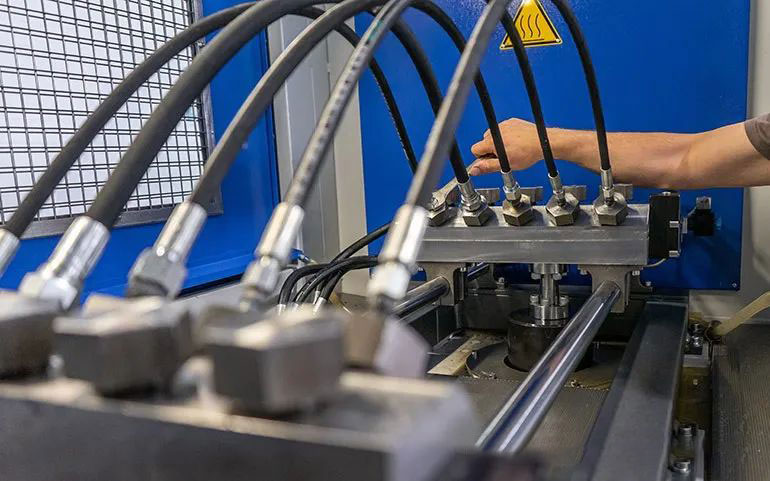
Using the SAE J343 test standard, we connect the hose to a test stand. We then test it to confirm that the manufacturer’s design and construction produce no less than four times the rated working pressure. In fact, most hoses exceed the minimum 4:1 rupture ratio, which makes sense if you’re the manufacturer. You’d rather consider any variation in material or construction from the factory on any given day, so that even a ‘bad batch’ can still meet the requirements.
In the SAE J343 test method for hydraulic hose, ‘burst’ is the point at which a hose fails due to rupture or bursting under pressure. This failure occurs when the internal pressure within the hose exceeds its maximum capacity. As a result, the hose experiences a sudden release of fluid and physical disintegration. During a burst test, a hydraulic hose is subjected to increasing pressure until it reaches the point of failure according to SAE J343. We record the pressure at which the hose bursts as the burst pressure or burst strength of the hose.
Part of the J343 standard defines the failure zone between operating pressure and total failure, which should still be of concern to the maintenance team. According to SAE J343, fatigue pressure is the pressure at which a hydraulic hose undergoes repeated cycles of pressure fluctuations without failing due to fatigue. We perform fatigue pressure testing to evaluate the durability and resistance of hydraulic hoses to cyclic loading. This testing simulates real-world conditions experienced during operation. According to SAE J343, we subject a hydraulic hose to a specified number of pressure cycles at a predetermined pressure amplitude during the test. The pressure amplitude typically ranges from hundreds to thousands. The pressure cycles involve alternating between high and low pressures. This simulates the fluctuations that occur during normal hydraulic system operation.
Fatigue pressure represents the maximum pressure that a hose can withstand for a specified number of cycles. We measure this endurance without observing signs of fatigue failure, such as cracking, delamination, or loss of structural integrity. In short, the fatigue pressure should also be more than twice the working pressure. This parameter is critical for assessing the long-term reliability of hydraulic hoses. It also helps evaluate their service life in applications subjected to repetitive pressure fluctuations.
With SAE J343, hydraulic hose burst and fatigue pressures provide important safety information. This data helps machine designers, technicians, and machinists gain peace of mind when installing hose assemblies.
Contact Zhuo Yi Control Technology for the latest production technology!