
You insert a cartridge logic valve, which is a logic element, into a valve body bore with different pilot control stages to form a variety of control valves or an entire control system.
logic element
You can combine the plug-in cone valve element in various ways with different combinations and pair it with the corresponding pilot control stage to create directional control, pressure control, flow control, and composite control units.
The cartridge logic valve itself lacks a valve body. Therefore, to assemble a complete logic valve, you must first mount and connect the logic element into the plug hole of the integrated channel block of the valve body. Depending on the method of connection with the valve body, the logic element can be classified into two types: cover plate and threaded. Notably, threaded connections are commonly used in hydraulic systems for construction machinery. This distinction underscores the specific application preferences and practical considerations involved in hydraulic system design.
Furthermore, the designers standardize and generalize the logic element, cartridge holes, cover plate assemblies, and other basic components. This standardization results in a high degree of modularity. As a result, these components exhibit small size, large flow capacity, minimal power loss, and fast action. Consequently, we find that they are particularly well-suited for large-flow integrated control and regulation. This, in turn, enhances their ease of integration and overall functionality within hydraulic systems.
How 2-way logic works
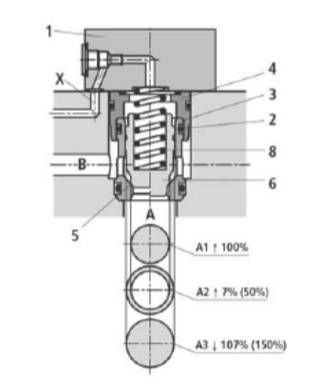
Cartridge valves consist of a spool, a spool ring, a spring, and a seal.
Each cartridge has two accesses to the main oil circuit, A on the front of the spool and B on the side of the spool ring.
When the spool is open, the A and B ports are the same. However, when the spool is closed, the A and B ports are interrupted. Therefore, its function is equivalent to a two-position two-way valve. As a result, we call it a two-way cartridge valve.
We can divide it into directional valve assemblies, pressure valve assemblies, and flow valve assemblies based on its different uses. The three assemblies of the same diameter have the same mounting dimensions, but the structure of the spool and the seat diameter of the valve sleeve are different. All three types of assemblies have two main oil ports A/B and one control port X.
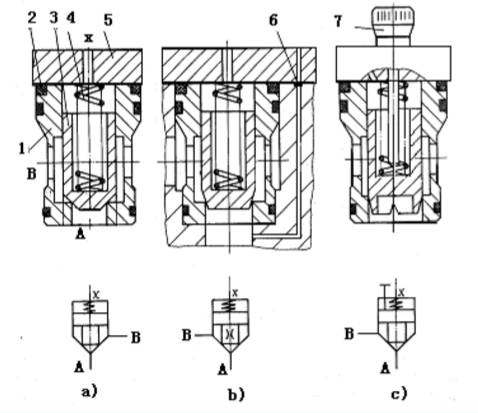
(a) Directional valve assembly (b) Pressure valve assembly (c) Flow valve assembly
Main combinations and functions of cartridge directional valves
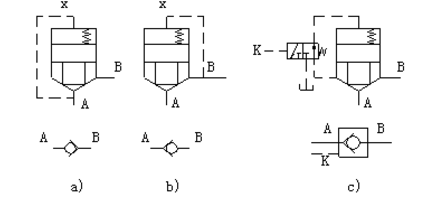
Make a check valve
A check valve is formed by connecting the X chamber to the A or B chamber. The way of connection is different and the way of conduction is also different.
If you connect a two-position, three-way pilot-operated directional valve to the control cover plate, you can create a pilot-operated check valve.
Make a two-position two-way valve
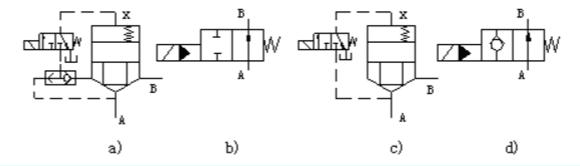
Make 2-position 3-way valve
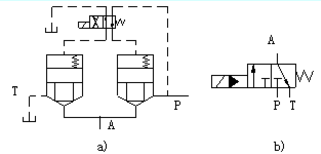
Make a two-position four-way valve

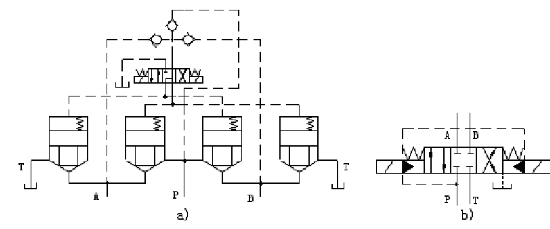
Make three-position four-way O-type directional valve
Issues for attention
Two-way cartridge valves offer significant advantages in large flow systems. They effectively reduce liquid resistance and pressure loss, which contributes to improved system efficiency. Additionally, they are more sensitive in opening and closing compared to traditional slide valves. Therefore, for hydraulic cylinder systems with large diameters and high flow rates, it is preferable to use cartridge valves to create the control circuit.
When designing the system, it is crucial to carefully select both the cartridge valves and the control oil ports. Specifically, it is advisable to route the control oil from the B port rather than from the spool control chamber X. By opting for this configuration, you can effectively avoid potential leakage between the B port and the spool control chamber X. This thoughtful approach addresses potential issues such as false operation. Additionally, it helps to minimize pressure loss caused by leakage. Consequently, this practice contributes to the overall reliability and efficiency of the hydraulic system.
Contact Zhuo Yi Control Technology for the latest production technology!


