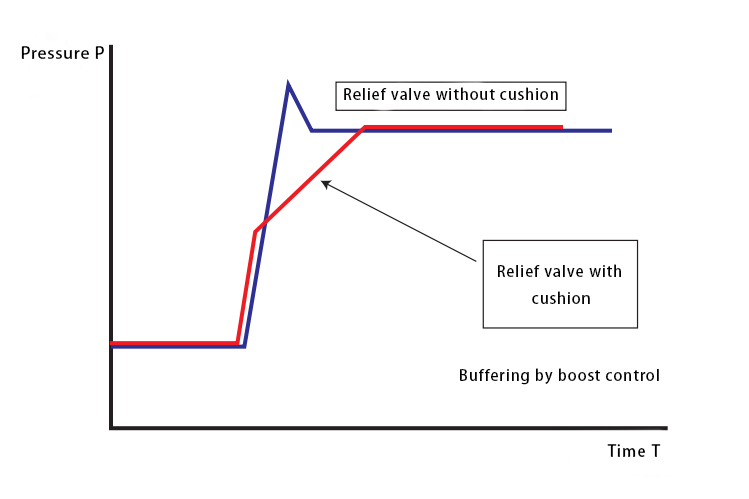
The rotary cushion relief valve is mounted on both ports of the motor to eliminate the shock of starting and stopping a large inertia load, as shown in the diagram below. As the pressure rises, the cartridge relief valve opens at a lower pressure so that there is no pressure shock. The red curve shows the effect with the cartridge relief valve, and the blue curve
The rotary start and stop of an excavator involve significant rotary inertia. During the process of starting and stopping, this large inertia leads to considerable pressure impacts. These impacts cause rotary swaying and poor maneuverability. Moreover, the large pressure impacts can damage the rotary structural components, motor, and other parts.
We divide the operation of the cartridge relief valve into four stages. The figure below shows the working process of each stage.
Stage (1): Initial tank pressure state
Stage (2): When the oil pressure acting on the plunger increases to match the force of the spring, the cartridge relief valve releases pressure to pressure P1.

Stage (3): When the oil pressure increases beyond the force of the spring, it will push the piston to the right. The load will increase as the spring compresses. Consequently, the unloading pressure P will rise gradually.
Stage (4): After the piston reaches the end part of the adjusting plug, it can no longer move to the left. It will return to the normal unloading state. The unloading pressure will keep Ps.

Contact Zhuo Yi Control Technology for the latest production technology!