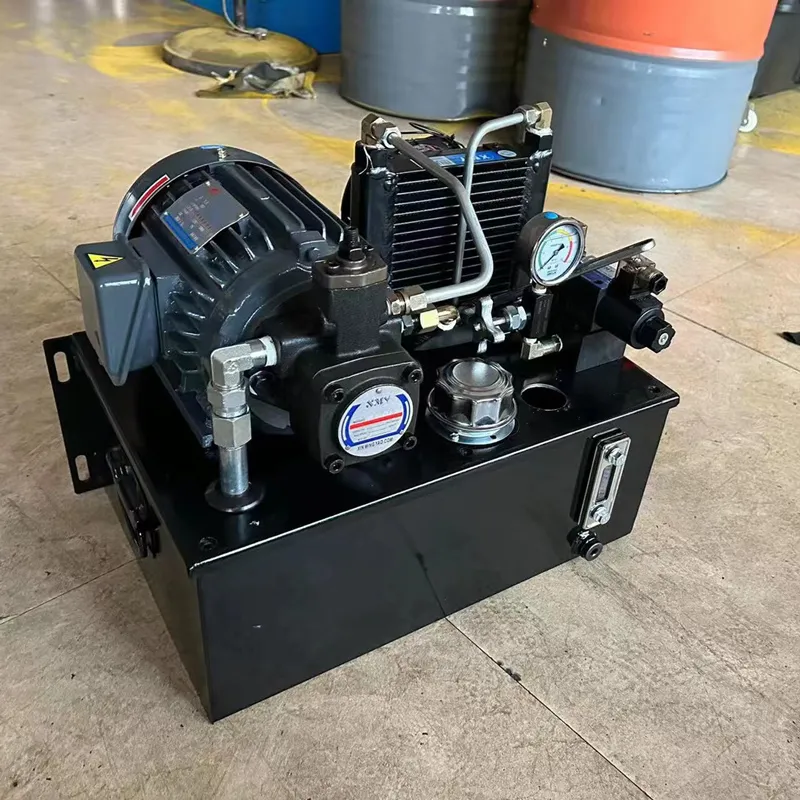
Hydraulic system in the custom hydraulic manifold deep hole machining accuracy is very harsh, wall thickness requirements are even more so; how to ensure that the deep hole machining process, deep and long holes in the machining of the dimensional accuracy of the parts, this paper Zhuo Yi hydraulic to discuss with you.
Chip removal when drilling
Poor chip removal in the drilling process, it is very easy to break the drill bit, especially in the CNC drilling process, once the drill bit breaks, it is very easy to cause the subsequent hole machining tool all damage. Therefore, to solve the problem of custom hydraulic manifold chip removal is particularly important.
In order to solve the problem of chip removal when drilling small deep holes, we have prepared a general-purpose drilling programme to solve the problem using macros. The main idea is that if the drilled hole is deeper, you should exit the chip removal every time the feed is less. Generally speaking, the hole depth is greater than 5 times the diameter of the case, each feed a depth of the drill diameter should be a chip removal. For strong, tough materials, the depth of one chip removal should be smaller. The advantages of compiling macro programs are that they can avoid lengthy programmes, are versatile and are easy to call up later.
Coaxiality of the hole to the outer circle
In the process of deep hole drilling, due to the existence of symmetry errors in the two cutting edges of the drill, the sharpness is inconsistent, etc., will cause the drilling process of the hole drift. Under normal circumstances 100mm drift value control in 0, 1mm there is a certain degree of difficulty. Usually, you will ream the hole after drilling if it has more stringent requirements. Reaming can control the hole diameter accuracy and improve surface quality. However, it cannot correct the drift generated by drilling.
To solve this problem, we break the conventional thinking. Although it is difficult to avoid drift when drilling, letting the outer circle adapt to the inner hole can still ensure the coaxiality requirements. The specific process steps are:
(1) Lower the material, leaving a margin of 2mm for the total length.
(2) Turn the left end face to see the light, and rough the outer circle to φ35,5mm.
(3) Clamp the roughly turned outer circle of the left end, finish turn the end face of the right end to ensure a total length of 80±0.05 mm, and drill and ream φ4.9±0.05 mm through holes.
(4) Remove burrs at both ends of the holes, and finish-turn φ34.9 mm outer circle with the two top tips of φ4.9±0.05 mm holes.
(5) Use the φ34, 9 mm outer circle as the reference to machine the remaining dimensions.
In this way, φ4,9±0,05 mm holes are machined first, and then the remaining dimensions are machined with φ4,9±0,05 mm holes as the reference, so that the drift error during the machining of φ4,9±0,05 mm holes is corrected in the later machining.
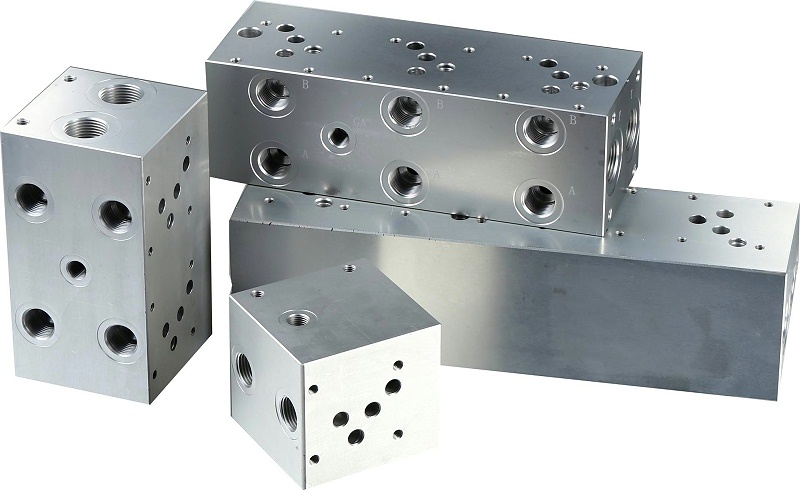
custom hydraulic manifold
Surface roughness requirements
The surface roughness value of Ra0, 8μm is not easy to achieve even under favourable cutting conditions, and it is even more difficult under these extremely unfavourable cutting conditions. If you make customized specialized rolling heads, you will find them more difficult to achieve due to high costs and long cycle times. The more economical method is still to ream with a reamer.
The characteristics of reaming have been summarised from experience as follows:
(1) Reduce the cutting speed;
(2) Select cutting fluid according to the processing material;
(3) Appropriately reduce the main offset angle, correctly sharpen the reamed cutting edge; appropriately reduce the reamed hole allowance;
(4) Improve the accuracy and quality of the bottom hole position before reaming or increase the reaming allowance;
(5) Use qualified reamers;
(6) Sharpen the width of the edge band;
(7) Reduce the number of reamer teeth according to the specific situation, increase the space of chip holding groove or use reamer with edge inclination, so that the chip discharge is smooth;
(8) Regularly replace the reamer and grind away the grinding area when sharpening;
(9) During sharpening, using, and transporting the reamer, you should take protective measures to avoid bruising;
(10) For the reamer that has been bruised, the reamer should be repaired with a special fine oil stone to repair the bruised reamer, or replace the reamer;
(11) You should repair the reamer with an oil stone until it meets the required standards, and use a reamer with a front angle of 5-10 degrees.
Contact Zhuo Yi Control Technology for the latest production technology!