
Two way cartridge valve is a hydraulic cartridge valve basic components, inserted into the specially designed and processed valve body, with cover, pilot valve composed of a multi-functional composite valve. Because each hydraulic cartridge valve basic assembly has and only two ports, so it is called two-way cartridge valve.
Features:
1、The spool is cone valve, good sealing performance, and sensitive action;
2、Large flow capacity, anti-pollution;
3, a valve multi-purpose, easy to form a variety of systems, compact structure. Especially for large flow and non-mineral oil media occasions, the advantages are more prominent.
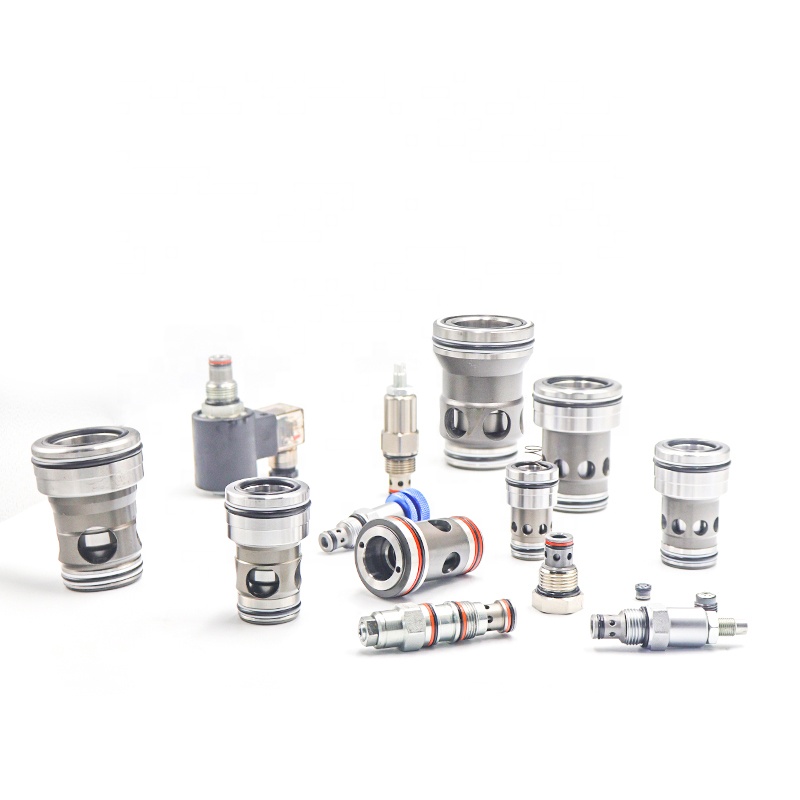
Classifications
We divide them into directional valve assemblies, pressure valve assemblies, and flow valve assemblies based on their use.
Principle
The main components of cartridge valves include the cone spool, valve sleeve, spring, and sealing ring. These components share the same installation dimensions for the same diameter, but the spool and sleeve seat diameters differ in their structural forms. Three kinds of components have two main oil port A and B and a control port C. Control port C manages the opening and closing of the main oil ports A and B. It does this by controlling the main valve spool. As a result, we can control the main oil line. Using different pilot valves, we can create pressure control, directional control, flow control, or even composite control.
The structure of the sketch shows that it has two pipeline connection ports, A and B, and a control port, C. The upper cavity of the cone valve connects to the pilot control valve, which controls the oil circuit. When the control oil port C connects to the oil tank, the cone valve opens, allowing oil to flow between ports A and B. Using the pilot control valve, you can depressurize or pressurize port C. This action allows you to achieve the opening and closing of the cone valve. The process is similar to the working principle of a hydraulic check valve.
The cone valve combined with a small flow solenoid valve can constitute a directional valve. For example, as shown in Figure (b), this combination forms a cone valve type directional valve. Additionally, the cone valve, when paired with various pilot pressure valves, can create different pressure control valves. As illustrated in Figure (c), this setup forms a cone valve pressure valve. Specifically, if port B is the return port, the valve functions as a relief valve. Conversely, if port B is connected to a branch of the system, the valve acts as a sequence valve.
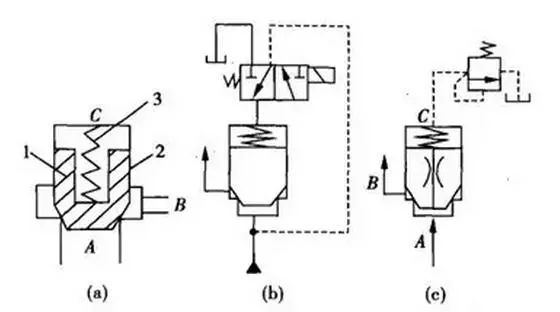
A cone valve can function as a directional valve, pressure valve, or throttle valve in the system. When used in conjunction with solenoid valves and pilot pressure valves, or with measures to regulate speed, it achieves these functions.
Contact Zhuo Yi Control Technology for the latest production technology!


