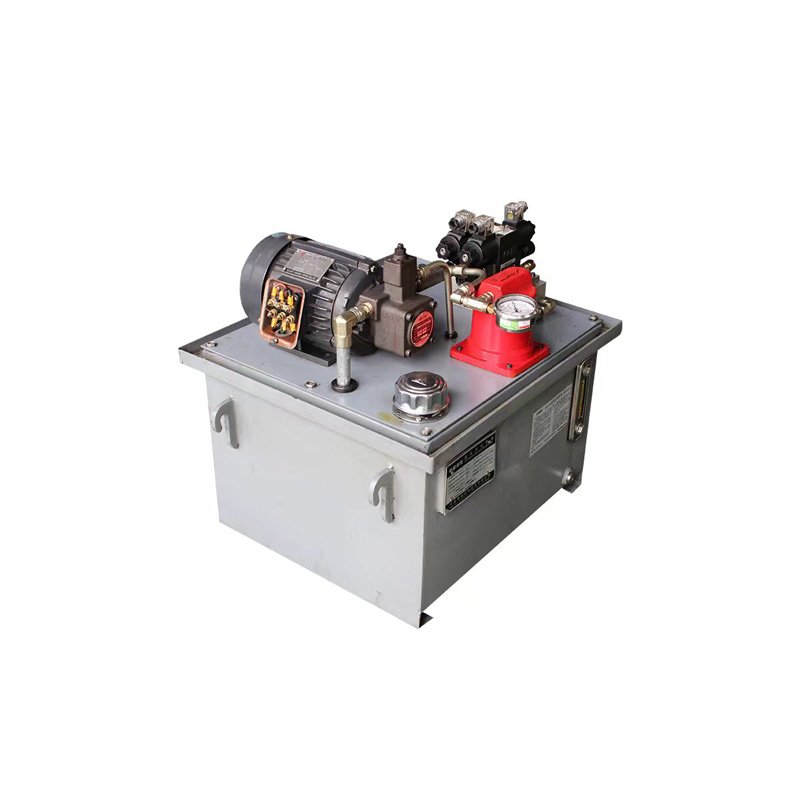
Common materials used for hydraulic valve blocks include hot rolled steel plates, carbon steel forgings and free cutting steel. In addition, grey cast iron castings, ductile iron castings, and aluminium alloy castings are used. Table 3-16 compares these materials. Selection should be based on the conditions of use.
| Table 3-16 Comparison of Materials Commonly Used for Valve Blocks | |||||
| Type | Working pressure/Mpa | Thickness/mm | Manufacturability | Weldability | Cost factor |
| Hot-rolled steel sheet | ≈35 | <160 | usual | usual | 1 |
| Carbon steel forgings | ≈35 | >160 | usual | usual | 1.5 |
| Free Cutting Steel | ≈35 | Rods, Plates | usual | usual | 1.5 |
| Grey cast iron | ≈14 | —— | good | unacceptable | 2 |
| Ductile iron | ≈35 | —— | usual | unacceptable | 2.1 |
| Aluminium alloy forgings | ≈21 | —— | good | unacceptable | 3~5 |
For the processing of hydraulic valve blocks, pay main attention to the following: the type of tool used for cartridge valve holes, the number of tool processing times, handling slender holes, cross-hole processing, and deburring methods. Also, master the wall thickness between the holes, conduct pressure resistance tests, and perform factory tests.
1) The cartridge valve manufacturer decides the size of the cartridge valve hole tool. We use international standards such as ISO 7789:2007, the Chinese standard JB/T 5693-1991, and the United States SUN T-type hole type.
2)The tool is a combination of good and bad quality for the number of machining may be twice the difference.
3) Slender hole generally refers to the hole diameter and processing length ratio of 20 ~ 30 or more holes, the need for special drilling casting head.
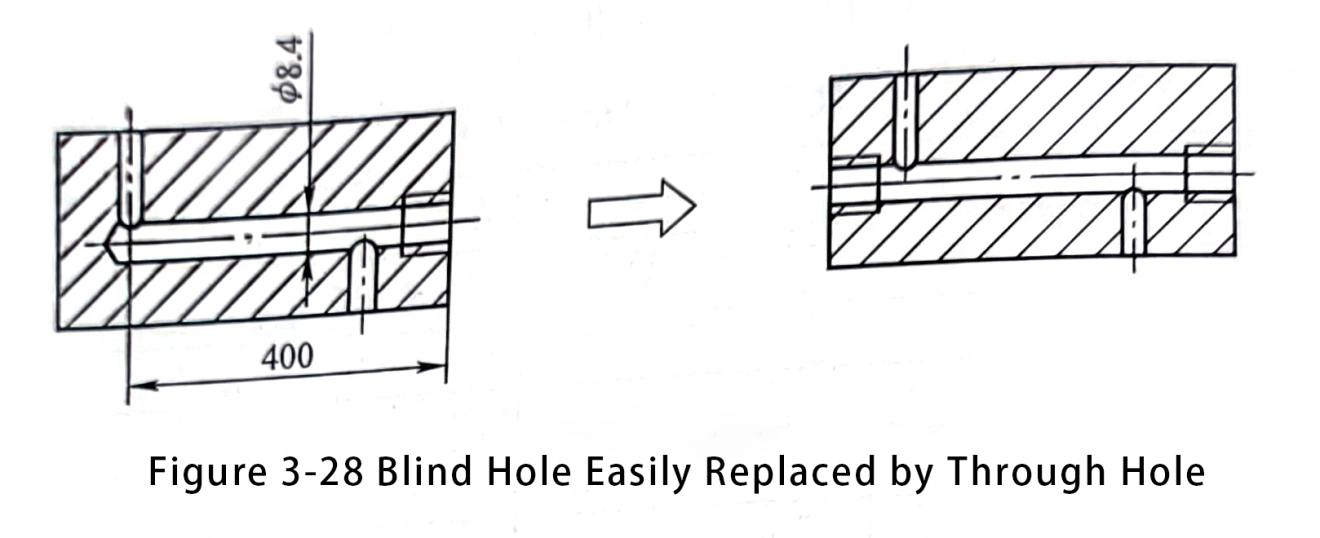
4) Avoid using crossed blind holes, as shown in Figure 3-28.
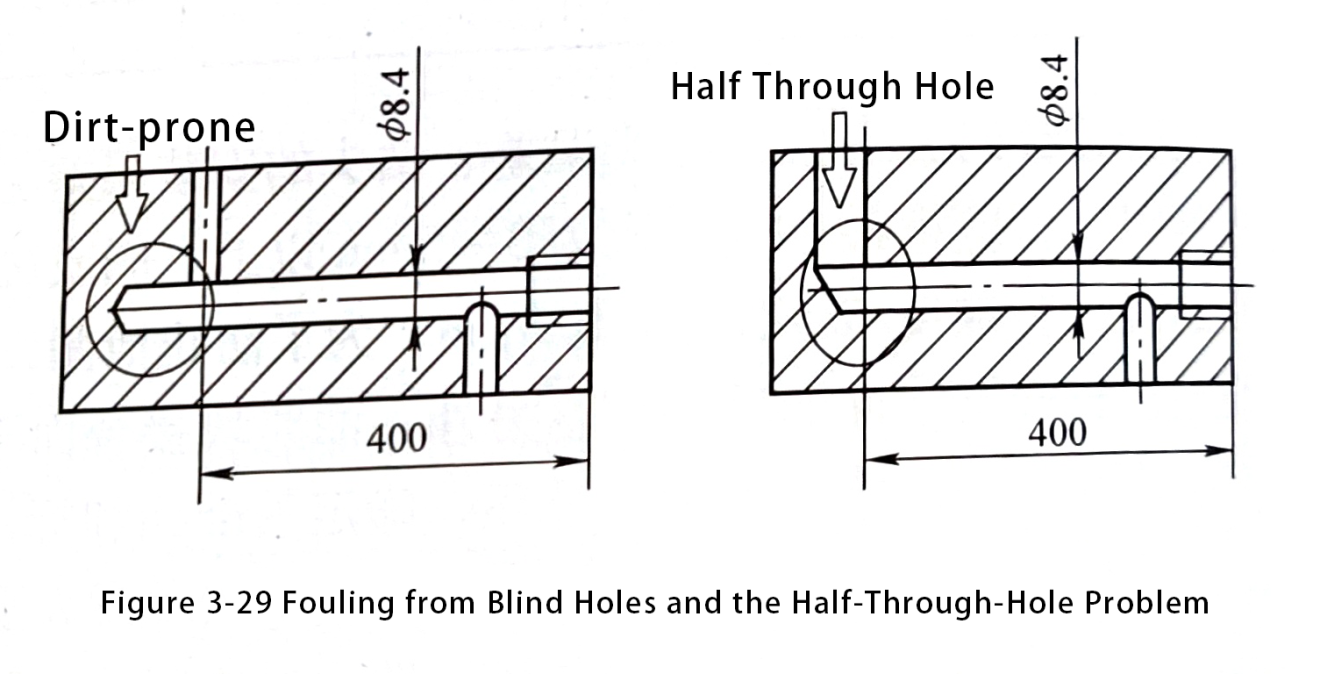
Crossed blind holes are prone to forming contaminant collection pockets and air pockets. These pockets tend to store swarf and are difficult to deburr. They can also result in a reduced through-flow area, such as with half-through holes, as shown in Figure 3-29.
Convert deeper broach holes to through holes by drilling from both sides and plugging one end, as shown in Figure 3-28. This improves processability. Craft hole plugs have related standards, such as tapered thread plug (JB/ZQ4446-1997 tapered pipe thread hexagonal screw plug; JB/ZQ 4447-1997 tapered thread hexagonal screw plug; JB/ZQ 4448-1997 tapered pipe thread small hexagonal screw plug; JB/ZQ 4449-1997 tapered pipe thread small hexagonal screw plug), straight-threaded plug (JB/ZQ 4450-1997 hexagonal plug), straight-threaded plug (JB/ZQ 4450-1997 hexagonal screw plug), straight-threaded plug (JB/ZQ 4450-1997 hexagonal plug), straight-threaded plug (JB/ZQ 4450-1997 hexagonal plug). 4450-1997 hexagonal screw plug; JB/Z0 4444-1997 hexagonal screw plug), ball up plug (JB/T 9157-2011 Hydraulic and pneumatic ball up plug size and tolerance), etc., of course, the process hole can also be used to weld the plug or blind flange plug. Plugs should be located in parts accessible without disassembling fittings, components or blocks to facilitate maintenance.
5) Deburring all points is the biggest headache, because the main cause of hydraulic valve clogging is poor burr removal. There are many ways to remove burrs. We most commonly use artificial deburring as a method. Additionally, we now use chemical cleaning methods, hydroxide breaking methods, and others to solve the burr problem.
6) Palm excavation should account for the whole thickness. However, for long and thin holes, aperture skew can cause wall thickness reduction or even create hole problems.
7) Voltage withstand test is the manufacturer factory than to do, is the bottom line of quality assurance.
8)The factory test serves as a quality assurance measure and can verify if something is incorrect.
In the case of intelligent manufacturing, all valve block processing will use CNC machines. This approach will reduce the problems mentioned above. You can record and trace processing and quality inspection, and strictly enforce all tests. The records will also be traceable, which helps to maximize the resolution of these problems.
Lastly, it is worth mentioning that traditional methods of machining hydraulic valve blocks face challenges from 3D printing. The 3D printing process ideally forms hydraulic valve blocks.
Contact Zhuo Yi Control Technology for the latest production technology!